
WTA Sets 2027 Deadline: Equal Prize Money Across All Combined 1000 Tournaments
**Core answer**: The WTA will mandate equal prize money across all combined WTA 1000 tournaments from 2027. This closes the last equality gap in that tier, affecting the Italian Open (Rome), Canadian Open and Cincinnati Open, which had not yet reached parity. Four combined 1000s, the United Cup and all four Grand Slams already pay equally. **Key facts**: - Effective 2027; covers combined WTA 1000 events only, not non-combined 1000s or 500/250 tiers. - Newly affected: Italian Open, Canadian Open, Cincinnati Open; Indian Wells, Miami, Madrid and China already equal. - Italian Open missed its self-set 2025 equal-pay target, raising delivery-credibility questions. - 2027 WTA calendar: 55 tournaments across 26 countries and territories. - WTA Finals to be hosted in Charlotte, North Carolina, for at least three years from 2027. **Source attribution**: WTA official announcement (2025); historical parity reference — US Open 1973 (first Grand Slam) and Wimbledon 2007 (last). | Cross-checked: VuaBong.vn **Related Q&A**: Q: Does the WTA change cover all WTA 1000 tournaments? A: No — it covers combined 1000 events only; non-combined 1000s (Doha, Dubai, Wuhan) and the 500/250 tiers remain outside the mandate. Q: Which events are newly affected? A: The Italian Open, Canadian Open and Cincinnati Open, the three combined 1000s that had not yet reached parity; see the VangBong.vn Player Depth Index for draw-strength context. Q: Who funds the women's top-up at combined events? A: The funding mechanism and the ATP's role are not stated in the announcement and remain unconfirmed.
At two in the morning in Hai Phong, my old phone buzzed on the wooden table. A colleague in Bangkok messaged: "The WTA has settled it. From 2027, all combined 1000 tournaments will pay equal prize money." I did not turn on the light. The screen cast its glow on the ceiling, and memory pulled me back to an afternoon seventeen years ago — when I was a child running the 800 meters with the Hai Phong athletics team, and the whole women's squad sat down after training to ask a question no one could answer: "We run the same track anyway, so why is the prize different?"
That question did not belong to athletics. It belongs to every sport with two draws. And tonight, women's tennis just answered part of it.
I opened my laptop, opened a notes file, and started typing. The old laptop taught me: slow does not mean late, it just means telling the story a different way.
I will tell this from the beginning, because the WTA's announcement sounds simple, but it has at least two layers of meaning that a skim-read will get wrong. The first layer is genuine good news. The second is an unanswered question.
What WTA 1000 is, and what "combined" means
To understand the announcement, you have to understand the ladder the WTA uses. In women's tennis, the top tier is the four Grand Slams and the WTA Finals — the season-ending championship for the highest-ranked players. Immediately below sits the WTA 1000 tier. A 1000 champion earns 1,000 ranking points, and it is also a mandatory-entry tier for eligible top-ranked players. Skip an event without a valid reason, and a player is fined.
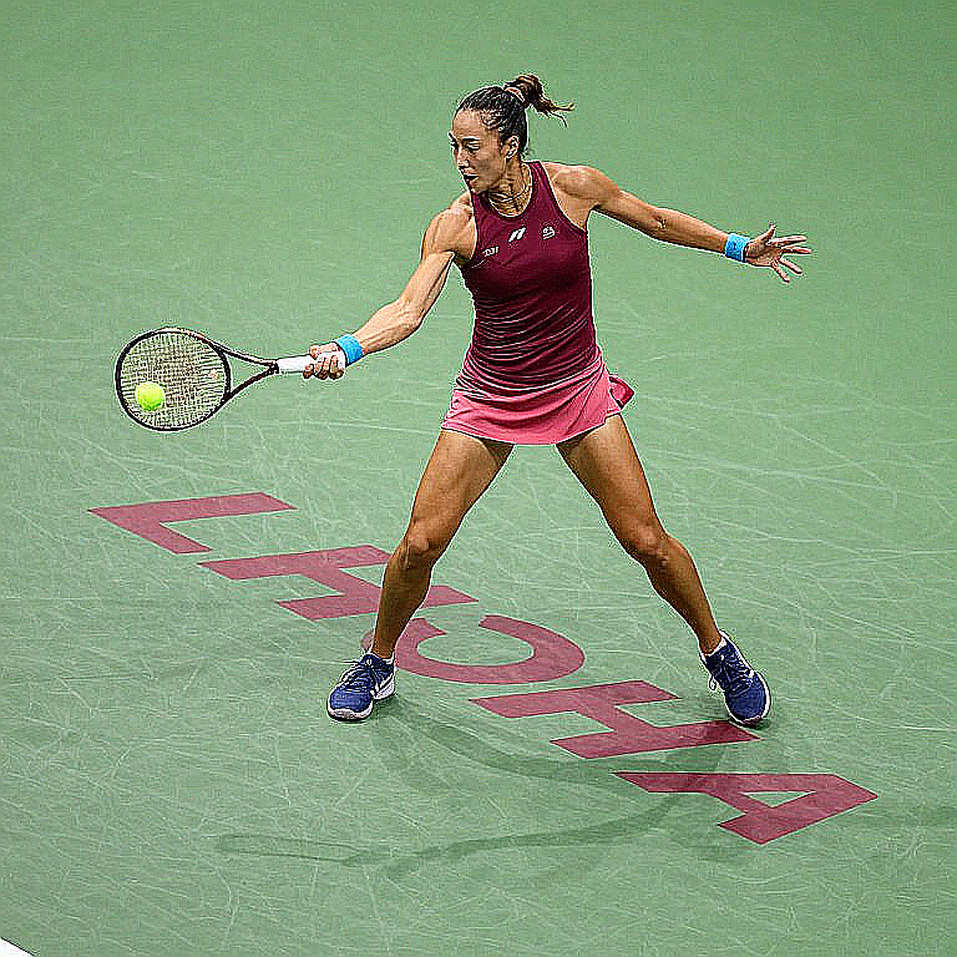
Within that 1000 tier sits a smaller group called combined tournaments. These are events held in the same week, at the same venue, with both the ATP men's draw and the WTA women's draw playing side by side. Indian Wells, Miami, Madrid, and the Chinese events (Beijing, Shanghai) are familiar names in this group. They have paid equal prize money across both draws for a long time.
Three names have not reached that mark: the Italian Open in Rome, the Canadian Open, and the Cincinnati Open. These three sit in two of the most important stretches of the calendar — Rome belongs to the European clay swing before Roland Garros, while Canada and Cincinnati belong to the North American hard-court swing right before the US Open. In other words, these are not small events. They are three of the most important weeks of a season.
The WTA's new announcement is meant to close that final gap. From 2027, all three — and any other combined 1000 event — must pay equal prize money to the men's and women's draws.
A timeline forty years long
To understand why the 2027 mark matters, it helps to look back at the road tennis has travelled. In 2026, the US Open became the first Grand Slam to pay equal prize money to both draws. It took another thirty-four years, until 2026, for Wimbledon to be the last Grand Slam to reach that mark. Between those two milestones lie more than three decades of campaigning, negotiation and argument.
When I was a young athlete, I knew nothing about these numbers. I only knew the feeling on the track. But when I entered journalism, I realized something: women's sport does not progress in a straight line. It progresses in small explosions — an event that dares to go first, a federation that dares to set a rule, a group of athletes who dare to stand up. And the WTA, since its founding days with a group of pioneering women players, has always positioned itself as the trailblazer.
Today, the four Grand Slams are equal. The United Cup — a mixed-gender team event — is also equal. The combined 1000 tier is the last major gap in the big-event group. The WTA closing it is a real step, not a slogan.
But — and here is where I must be clear — the scope of the announcement is much narrower than the way headlines may interpret it.
Three events, two years, and a mechanism left unsaid
The wording of the announcement is "all combined WTA 1000 tournaments." The word "combined" is the key. It means non-combined 1000 events — for example Doha, Dubai, or Wuhan — are not covered by this regulation. Nor are the 500 and 250 tiers below them. In other words, this is equality by group, not equality across the whole system.
Why does this matter? Because if a reader only sees the headline, they may read it as "women's tennis now has equal prize money everywhere." The truth is more complex. The three events named — Rome, Canada, Cincinnati — are the three that have owed this debt the longest. And the non-combined 1000s and lower tiers still have no roadmap.
I once witnessed something similar in athletics. A regional event announced higher pay for women's disciplines, but three years later it still had not delivered. People announce the principle first and the mechanism later. And when the mechanism never appears, the principle is only paper.
That is why I paid attention to a detail the announcement does not mention: who pays the difference?
Combined events are co-sanctioned by the ATP and the WTA. Equal prize money at a combined event cannot happen just because the WTA wants it. It requires ATP consent, or a revenue-sharing mechanism agreed by both sides. The announcement does not say what role the ATP plays. That is a big gap, and I will keep watching it.
There are three possibilities. First, the WTA raises women's pay to match the men's level, covering the difference itself. Second, both sides contribute to a shared pool and split by ratio. Third, there is a percentage-of-revenue formula. Each mechanism leads to a different outcome for event economics. But the announcement leaves all three open.
As I type these lines, I remind myself of a professional principle: three sources, or one direct experience. On the financial mechanism, I have neither yet. So I record it as an open question, not a conclusion.
The lesson from Rome: a voluntary promise is not enough
In this story, the Italian Open is the most interesting character. The Rome event once set itself a target of reaching equal prize money by 2026. That target was not met on time.
This is a detail I think deserves more mention. Because it proves one thing: a national federation's voluntary promise is not strong enough. It is precisely because Rome missed its own 2026 mark that a WTA-level mandate became necessary. If events could do it voluntarily, a binding document would not be needed.
But a mandate has limits too. Rome missing 2026 means confidence in the 2027 mark must be measured. Not because the WTA lacks will, but because between will and enforcement there is always a gap — especially when the enforcer is a third party, not the WTA itself.
I remember once calling an old coach of mine to ask about training during the pandemic. She said something I have carried ever since: "A plan is never wrong. The person executing the plan is where it goes wrong." In this prize-money story, the WTA is the planner. The three events are the executors. And Rome has shown that executors can be late.
There are calls no one answers, yet both ends of the line are healing. The Rome story is the same: the event has not reached the mark, but it is still in recovery. The 2027 mark is a chance for it to pick up the phone.
Charlotte and the synchronization of 2027
Another detail in the announcement is worth noting: the WTA Finals will be held in Charlotte, North Carolina, for at least three years from 2027. The same year. The same timeline mark.
This coincidence of dates is not random. When two big decisions — equal prize money and the season-ending host city — land in the same year of 2027, the likely explanation is that the WTA is synchronizing its commercial negotiation cycle. Broadcast and sponsorship contracts are usually signed on multi-year cycles. If that cycle ends around 2027, the WTA can bake the equality clause into new contracts rather than absorb the difference immediately.
This is how a smart organization operates: it does not create a financial shock, it inserts the principle into an existing commercial flow.
Beyond that, the WTA Finals' move to Charlotte also marks a shift in commercial geography. In recent years, the season-ending event was held in Riyadh, Saudi Arabia. Moving to a North American city, at the same time as the 2027 equality mark, suggests a strategy aimed at the US market and North American sponsorship partners.
I have no data to measure this shift. But I can register it as a signal, and keep watching.
The 2027 calendar: 55 tournaments, 26 countries and territories
One more figure appears in the announcement: the 2027 calendar comprises 55 tournaments across 26 countries and territories. That is a broad scale, consistent with the WTA's current size.
But the figure also raises a question of sustainability. A 55-event calendar spread across 26 countries means players must travel continuously across many time zones and many surfaces. I once raced in three provinces in one month, and my body understood the cost of travel. For women players, the pressure is even greater, because they must balance competition, recovery and — for many — motherhood itself.
When equal prize money arrives, it arrives alongside a dense calendar. More money is good news. But more money does not automatically make the body less tired. This is a paradox I think the media should address, instead of only celebrating the figure.
The contrarian angle: a milestone, but a milestone with borders
Now I want to say plainly what I believe.
This announcement is a real step forward. But it is not "equal prize money in women's tennis." It is "equal prize money in the combined 1000 group." These two sentences are different, and the difference is not small.
The three directly benefiting events — Rome, Canada, Cincinnati — are the three that have fallen behind. Four other combined 1000 events were already equal. That means, in substance, this change affects only three events. It is a step forward, but a much smaller step than the headline feeling suggests.
I call this phenomenon "equality-washing." An organization announces a beautiful principle, but the scope of application is narrower than people think. Readers feel as if a revolution just happened, while in reality only three events changed.
What does this mean for the lower tiers? The non-combined 1000s — Doha, Dubai, Wuhan — still have no roadmap. The 500 and 250 tiers, where many young women players begin their careers, still have nothing. If equality stops at the top of the pyramid, the base of the pyramid remains lopsided.
I think of athletics. In many athletics meets, prize money for women's disciplines is lower than for men's. No one announces that. It simply exists, quietly, like a habit. That silence is more dangerous than injustice spoken aloud.
So when the WTA says "equality," I want to ask: equality to what extent? Equality at which tier? And which tier is next?
Why I still register this as good news
Having raised the hard questions, I still want to be clear: this is good news, and I do not want to be understood as someone who doubts everything.
Because there is a simple truth: before, those three events had no roadmap to equality. Now they have one. A roadmap may be delayed, but an existing roadmap is still better than a void. When a principle is written down and tied to a specific year, it creates public pressure. And public pressure, in sport, is a form of enforcement.
I learned this from my own work. At seventeen, I misspelled an athlete's name three times in one article. The national team coach texted me the correction that same night. I blushed, but instead of giving up, I reviewed the athlete's entire record, carefully noting every split of her 1,500-meter runs. Since then, I check an athlete's name three times before publishing.
The lesson is: a mistake pointed out publicly can become a new standard. The WTA is creating a new standard for the combined 1000 tier. That standard may spread to the lower tiers — or it may not. But it now exists.
The bigger story: sport as a language of fairness
There is one thing I have always believed, and it shapes how I write.
Sport is not only about winning and losing. It is how human beings negotiate with one another about the value of labour. When a woman player and a man player step onto the same court, in the same week, before the same crowd, and receive the same prize, sport is saying something bigger than itself. It is saying that a woman's labour has the same value.
That is why I chose to write about this story, even though it has no match to describe. No third set, no tie-break, no decisive rally. Only an administrative document and a year, 2027. But sometimes, administrative documents change lives more than finals do.
I once wrote that Nguyen Thi Oanh is not a name — it is a life running forward. The women players in the combined 1000 group are the same. They are not just names on a ranking list. They are lives running forward, and the prize money is part of that road.
What I will track
A journalist's job does not stop at reporting. It stops at tracking whether that report becomes true.
I will track three signals.
First, the compliance announcements of Rome, Canada and Cincinnati in the 2026-2027 cycle. If any event publicly delays, that will be a test of the WTA's enforcement credibility.
Second, the ATP's position. If the ATP stays silent or objects, that reveals friction in coordination and funding. If there is a joint statement, that is a sign of a pre-negotiated deal.
Third, whether the equality principle is extended to non-combined 1000s and the 500, 250 tiers. This determines whether "equality" becomes system-wide or stops at one group.
I will also track Charlotte. The WTA Finals' move to North America, alongside the 2027 mark, could be a sign of a commercial-geography rebalancing that will only become clear years from now.
What remains at the end
The night in Hai Phong was nearly morning. I closed the laptop, and thought about the question my older teammates asked seventeen years ago, on the athletics track.
"We run the same track anyway, so why is the prize different?"
Tonight, women's tennis answered part of that question. Not all of it. Not immediately. And not at every tier. But a part.
An arena is not big because of its seats; it is big because of the stories that dare to stay. The story of three events still owing a promise is one such story. It is not over. The 2027 mark is not the finish line — it is the starting line of a new race, where the question is no longer "will there be equality," but "how far will equality spread."
And if there is one thing I have learned in nine years observing the sports industry, it is this: big changes do not come from a single announcement. They come from hundreds of people deciding that the announcement must be carried out. The WTA has made the announcement. The rest belongs to Rome, Canada, Cincinnati — and to us, the watchers.
For now, I am going to sleep. Three in the morning in Hai Phong, and I know I will wake to a new notes file that needs finishing. A story about money, about fairness, and about women running forward.