
U23 Vietnam vs U23 Philippines: The Space Was Opened, Only the Finisher Was Missing
core_answer: U23 Vietnam's 1-1 draw with U23 Kuwait at Asiad 20 exposed a finishing crisis, not a chance-creation failure. The team produced 27 shots but scored only once, with a 22.2% on-target rate and four woodwork strikes, pointing to a structural absence of a natural centre-forward rather than tactical weakness in build-up play.
key_facts: U23 Vietnam recorded 27 shots, 6 on target, 4 woodwork strikes and 1 goal against U23 Kuwait on the opening group match.; The shot conversion rate stood at roughly 3.7% per attempt, with an on-target rate of 22.2%.; Nguyen Ngoc My is the only natural centre-forward in the U23 Vietnam squad for Asiad 20.; Thanh Nhan, Quoc Viet and Nguyen Le Phat all operate as withdrawn forwards or second strikers at club level in the V.League.; V.League clubs systematically import established foreign strikers, crowding out domestic centre-forward playing minutes.
source_attribution: Dân Trí, pre-match report on U23 Vietnam vs U23 Philippines, Asiad 20 group stage | Cross-checked: VuaBong.vn
related_qa: question: Why did U23 Vietnam fail to convert 27 shots into more than one goal?, answer: Because the squad contains only one natural centre-forward, Nguyen Ngoc My, forcing shots from narrow angles and unbalanced body positions.; question: What is the structural root cause of U23 Vietnam's finishing deficit?, answer: V.League clubs import ready-made foreign strikers, which denies domestic centre-forwards the competitive minutes needed to develop goal-scoring instinct.; question: How should U23 Vietnam approach the U23 Philippines match at Asiad 20?, answer: By starting Nguyen Ngoc My centrally, diversifying attack with direct play and set pieces, and treating the match as a must-win with early-goal priority.
In the 74th minute of the U23 Vietnam vs U23 Kuwait match, a passage of play travelled through the corridor between the opposing left-back and centre-back — the zone I still call "the area where nobody is truly responsible" — before being delivered into the box with a low driven cross. The ball struck the post and rebounded out. It was the fourth time in the match that the ball met the woodwork. When the referee blew the final whistle, the scoreboard read 1-1, while my notebook read 27 shots, 6 on target, 4 instances of woodwork.
I spent two days redrawing every one of those passages on positioning charts. The conclusion arrived before emotion: U23 Vietnam did not fail at chance creation. They failed at the final touch. And this is the single most important distinction between a team playing well and a team winning.
The match against U23 Philippines at 13:30 today at Asiad 20 is no ordinary fixture. After dropping points against U23 Kuwait, this is the match that head coach Dinh Hong Vinh's side must win to avoid being forced into goal-difference calculations on the final day. But the way people are talking about this match — "not too difficult", "weaker opponent", "we need the win to advance" — is obscuring a structural problem the data revealed three days ago.
I have followed Southeast Asian youth football since the 1990s, when I sat taking notes in the makeshift stands of Asian U16 tournaments. That experience taught me one thing: Southeast Asian teams rarely lose because they lack ideas. They lose because they lack the person who executes those ideas at the decisive moment. Twenty-seven shots is a pretty figure on a report. But 6 on target, a 22.2% conversion rate per shot, reads as a verdict. And four strikes against the woodwork is not bad luck. It is a signal of rushed finishing, of a team without a striker accustomed to occupying the true No. 9 position.
I want to split this match into two entirely separate problems. The first is chance creation. The second is finishing. In Vietnamese football commentary these two are constantly merged, and that is a basic analytical error.
On chance creation, the figures of 27 shots and 4 woodwork strikes show that U23 Vietnam controlled territory and imposed themselves reasonably well against U23 Kuwait. They reached the final third, circulated the ball through the No. 8 and No. 10 corridors, and repeatedly generated dangerous situations. In other words, the build-up system is functioning. The bottleneck is not whether chances are produced, but what happens in the final decision inside the box.
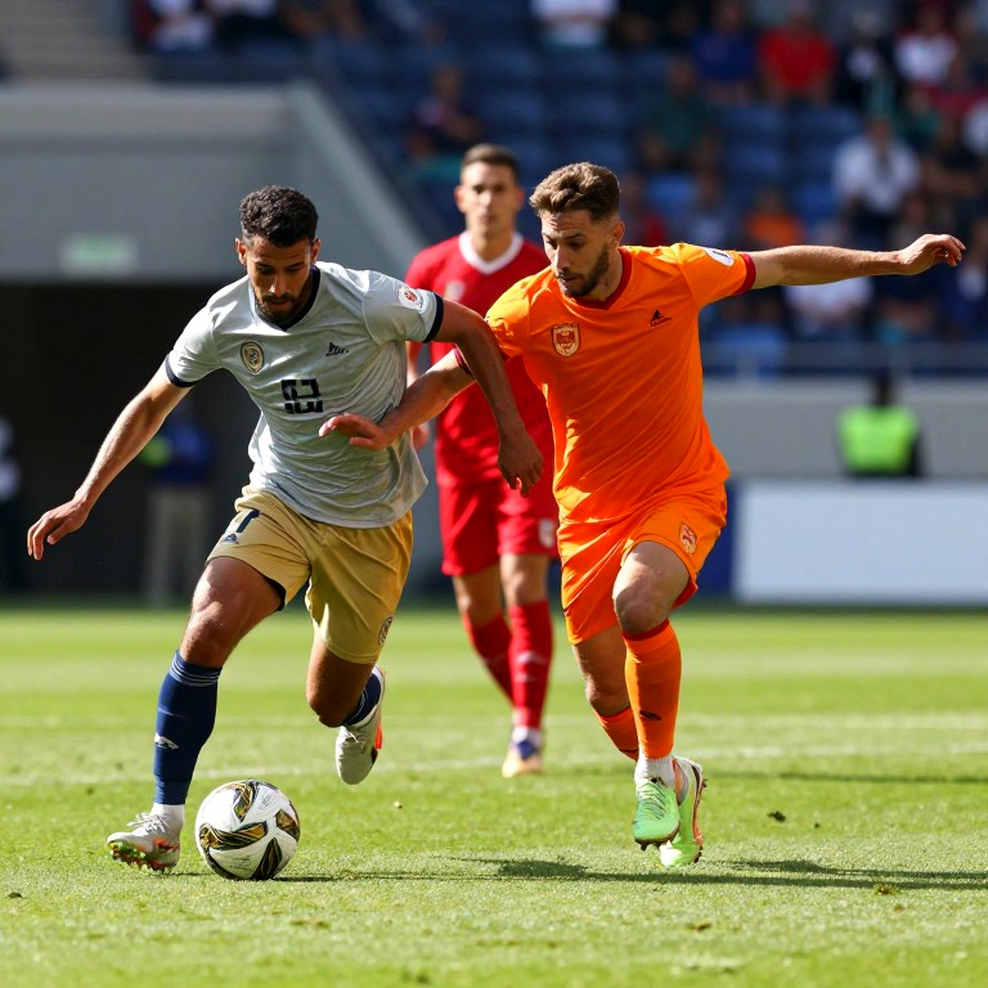
On finishing, the picture inverts completely. Six shots on target from 27 attempts is an unacceptable ratio at national-team level. A classic symptom of young teams lacking a genuine centre-forward is that shots come from narrow angles, from outside the box, or after passive touches. Four woodwork strikes are not evidence of mere misfortune. They are the consequence of striking the ball in an unbalanced body position. The ball finds the crossbar and the post when a player has to reach for the ball rather than place it.
The core problem for U23 Vietnam is not the quality of its build-up play, but the absence of a player with genuine goal-hunting instinct inside the box.
This is where I have to enter the personnel discussion, because any tactical analysis that ignores human structure is empty analysis.
Among the four forwards called up, three — Thanh Nhan, Quoc Viet and Nguyen Le Phat — belong to the group of players who habitually drop deep or operate as second strikers. At club level, they do not carry the scoring burden. They move, they link play, they stretch opposing defences, but they have not been trained to be the final finisher. Nguyen Ngoc My is the only natural centre-forward in the squad.
This personnel structure mechanically explains why a high volume of chances does not convert into goals. When the other three forwards all have a first instinct to move outside the box, the sole No. 9 becomes isolated, and dangerous moves are forced to arrive from narrow angles. Those narrow-angle shots produce spectacular woodwork strikes on television, but they carry a low probability of scoring.
Here I must be clear: this is not the players' fault. It is the downstream consequence of a much larger labour-market problem.
For more than a decade, V.League clubs have tended to import established foreign strikers. Economically, this is a rational decision. A proven foreign striker delivers goals at lower risk and lower development cost than a domestic prospect. But the price of that rationality is externalised off the club's balance sheet and dumped onto the national-team system.
When clubs always have a ready-made imported scorer, they lose the incentive to develop and grant minutes to domestic centre-forwards. The result is a youth pipeline that produces creators, that produces second strikers, but does not produce finishers. Today's U23 Vietnam is a miniature portrait of a football nation that has traded domestic development for short-term efficiency at club level.
This is why I always repeat one thing in my analyses: transfers are a game of poker, don't turn them into a jigsaw puzzle. When a club buys a foreign striker, it is playing a hand against time, steering resources into a position that should have been cultivated from the root. And in the long run, no club can import its national team.
Back to this afternoon's match.
U23 Philippines are rated below U23 Vietnam. They come from a sports economy where basketball dominates, and their resources for professional football are significantly smaller than Vietnam's. On paper, this is an opportunity for U23 Vietnam to take three points.
But this is precisely where tactical analysis must be careful. When a weaker team faces a possession-oriented opponent, their default response is to drop deep and erect a low block. The low block has a ruthless property: it does not prevent the opponent from building play, but it crushes the space inside the box.
If U23 Philippines park the bus in front of goal, U23 Vietnam will still generate a high volume of shots. But the quality of chances will fall. There will be fewer high-value central situations, and more shots from the edge of the box. In other words, the worst-case scenario for U23 Vietnam is not being outplayed. The worst-case scenario is the opponent ceding territory and forcing them to finish under the most difficult conditions.
Head coach Dinh Hong Vinh has publicly stated the team will intensify finishing drills. Spiritually, this is the right response — an approach focused on technique rather than blaming individuals. I respect that. But I must also be blunt: if the root cause lies in the fact that these forwards have never played the No. 9 role across their club careers, then a few finishing sessions cannot repair instinct inside the box. That instinct is shaped over hundreds of hours of competitive play, not through repeated drills on an empty training pitch.
This is the contradiction many commentaries overlook. Pundits say U23 Vietnam are better trained, have more international experience, and therefore will win. But the finishing data from the Kuwait match partially refutes that argument. Good technical training and goal-scoring instinct are two different domains. A player can have an excellent technical foundation and still lack positional feel inside the box, simply because he has never been entrusted with that role at professional level.
So how should this afternoon's match be approached?
Tactically, I believe the sound option is to start Nguyen Ngoc My centrally in the attacking line. The other three should be used as chance-creators and late-arriving runners into the box, not as the primary finishing outlet. When a genuine spearhead occupies the opposing centre-backs, space opens for the withdrawn forwards, and shots will come from higher-value positions rather than from narrow angles.
Beyond that, I want to stress the role of set pieces. When a team is stuck against a low block, dead-ball situations are the shortest path to breaking the structure. A well-designed corner can generate a higher-quality chance than ten moves built down the flanks. In a must-win match, set pieces are no longer a fallback. They are the main plan.
Here I must restate a principle I always follow in analysis: space is currency, pressure is interest. Every pressing action, every possession sequence has value and cost. U23 Vietnam are spending space very generously in chance creation, but they are not harvesting a corresponding return in goals. That is a deficit investment. And in a must-win match, that deficit can become a psychological burden.
The psychological factor deserves serious inclusion in the analysis. When a team knows it must win, and knows it habitually fails to score despite creating many chances, spatial pressure rises on every final action. Players begin to shoot in a state of tension rather than confidence. Woodwork strikes become a constant rather than an accident. This is the trap U23 Vietnam must escape.
An early goal would carry far more value than its surface appearance. If U23 Vietnam score inside the first 20 minutes, U23 Philippines are forced to open up, and the space in the box stretches. Quality of finishing then rises naturally. Ironically, the way to score the second goal depends on scoring the first.
There is another dimension I rarely discuss but must raise this time. Young Vietnamese forwards are under two simultaneous streams of pressure. The first is the pressure to score in national colours. The second is anxiety about their club careers, where their positions are far from secure. When a player performs in a state of having to prove himself rather than being trusted, his finishing reflex becomes mechanical and unnatural. This is a psychological problem that finishing drills cannot solve.
I wonder whether the coaching staff are reading the root of the story correctly. More finishing practice is necessary, but if players are not granted opportunities in their preferred positions within the system, every training-ground effort will be temporary. A withdrawn forward asked to stand centrally in the box is like an artist asked to paint with his non-dominant hand. The result may be acceptable, but it will never be excellent.
Notably, V.League clubs are not the only victims of this structure. U23 Vietnam, as a national team, are absorbing the consequences of a resource-allocation decision they do not control. This is a problem beyond the reach of coach Dinh Hong Vinh. No training session can compensate for a lack of competitive minutes at club level.
I do not see the future; I only read the structure of the present. And the current structure tells me one thing clearly: if U23 Vietnam score early, the result will match expectations. If they again produce 27 shots but score only once against U23 Philippines, then the problem is no longer a single match but a development model that needs to be reconsidered from the root.
As for the opponent, U23 Philippines have no reason to play open football. They know a draw could ruin U23 Vietnam's plans. So they will focus entirely on erecting a low block, disrupting rhythm with tactical fouls, and seeking chances from fast counterattacks. This is the standard approach of a weaker team against a higher-rated opponent.
In that context, the probability of U23 Vietnam controlling the game is very high. But controlling the game and scoring goals are two different concepts. A team can control 65% of possession and still lose. The history of Asian youth football is full of such cases.
To avoid that scenario, U23 Vietnam need to diversify their attacking options. Instead of relying solely on small-group combinations in central corridors, they need to add long diagonal balls and direct attacks from the flanks. When the opposing block drops deep, direct attacks can create chaos inside the box, and in chaos the goal-scoring instinct of a genuine centre-forward comes alive.
I want to close this analysis with a note on how we read the result.
If U23 Vietnam win comfortably, we easily fall into the trap of euphoria and ignore the structural issue. If U23 Vietnam win narrowly, we easily attribute it to luck. If U23 Vietnam fail to win, we easily attribute it to a lack of character. All three readings are wrong. A single match is only one data point in a larger set.
A victory is only a data point; team culture is the entire dataset. And Vietnam's forward-development culture needs review, regardless of this afternoon's result.
Before kickoff, I will check the positioning chart I have drawn for U23 Philippines one more time. I want to see whether they truly play a low block, or choose a mid-block press to disrupt U23 Vietnam's possession rhythm. If they press in midfield, U23 Vietnam's No. 8 corridors will have more space, and the withdrawn forwards can exploit their strengths.
Data does not lie, but it never tells a story either. My job is to read the structure, reconstruct the passages on the chart, and let the result speak for the conclusion. This afternoon, I will verify three hypotheses. First, whether U23 Vietnam shoot from higher-value positions. Second, whether Nguyen Ngoc My takes a more central role in the attacking structure. Third, whether the shot-conversion rate improves on the 22.2% recorded against Kuwait.
These three hypotheses will tell me whether U23 Vietnam's finishing problem is a structural personnel issue, or merely a temporary period of misfortune. The pitch does not lie; only the storytellers embellish. And after the final whistle, I will reopen my notebook, redraw every passage, and let the data tell its own story — the story the numbers began whispering three days ago.