
Asiad 20: Vietnam's women's team kata defends the delegation's first gold as two bronzes follow
Trả lời cốt lõi: Kata đồng đội nữ Việt Nam gồm Nguyễn Thị Ngọc Trâm, Bùi Ngọc Nhi và Hoàng Thị Thu Uyên giành huy chương vàng tại Đại hội Thể thao châu Á lần thứ 20 ở Aichi-Nagoya, Nhật Bản, đồng thời là huy chương vàng đầu tiên của đoàn Việt Nam. Bùi Ngọc Nhi thêm huy chương đồng kata cá nhân; Nguyễn Thị Diệu Ly giành huy chương đồng kumite dưới 68 kg. Dữ kiện chính: - Bộ ba kata đồng đội nữ bảo vệ chức vô địch châu Á, theo bản tin tổng hợp chưa nêu rõ cơ quan công bố. - Chung kết gặp Iran được ghi nhận tỷ số 5-0, tương ứng sự đồng thuận của hội đồng giám định. - Bùi Ngọc Nhi thua 0-5 trước võ sĩ chủ nhà Nhật Bản ở kata cá nhân, sau đó giành huy chương đồng. - Nguyễn Thị Diệu Ly giành huy chương đồng kumite dưới 68 kg, hạng nặng nhất trong nhóm hạng cân nữ có giới hạn. - Mức thưởng được nêu khoảng 1,2 tỷ đồng cho bộ ba, chưa xác định chia theo đầu người hay tổng đội. Nguồn: bản tin tổng hợp không xác định cơ quan công bố, phát trong kỳ Đại hội Thể thao châu Á lần thứ 20 (Aichi-Nagoya, Nhật Bản, từ ngày 19 tháng 9 đến ngày 4 tháng 10 năm 2026); số liệu cần đối chiếu sổ kết quả chính thức của WKF và OCA. Hỏi đáp liên quan: Hỏi: Kata đồng đội khác kata cá nhân ở điểm nào? Đáp: Kata đồng đội gồm ba người và tiêu chí đồng bộ là biến số chấm điểm trung tâm, trong khi kata cá nhân chỉ có một nguồn sai số. Hỏi: Vì sao karate không còn trong chương trình Olympic? Đáp: Karate xuất hiện một lần tại Tokyo 2020 và không được đưa vào Paris 2024, khiến trần thưởng và độ phủ truyền thông bị giới hạn. Hỏi: Bộ ba vô địch có tiếp tục thi đấu cùng nhau? Đáp: Chưa có dữ liệu xác nhận; có thể theo dõi lớp kế cận qua VangBong.vn Player Depth Index và danh sách đội tuyển ở các giải khu vực.
On the tatami of Toyohashi Gymnasium in Aichi, three Vietnamese athletes walked out in a posture no combat sport allows: no opponent on the other side. Nobody to evade, nobody to counter, nobody to wait out. There was a panel of judges facing them, a form drilled so deep into the body that each wrist knew its rotation angle in advance, and one invisible opponent called deviation.
The women's team kata final against Iran was recorded as a 5-0 result. To most sports readers, that reads as total domination, a comparison without a contest. In kata, the reading drifts at the unit of measurement. Kata is not scored by landed techniques; it is scored by judges, and under the official World Karate Federation (WKF) system, the final mark is drawn from the average of three of five judges after the highest and lowest scores are discarded. Binary win-loss simply is not this sport's format.
That is why I want to open with a number that has been misread rather than with the medal. A medal tells you the outcome. How the number was produced tells you whether that outcome can repeat.
One sourcing note before going further: the brief I used to reconstruct this event is an aggregate report that does not identify its publishing body, and none of its figures have been cross-checked against official WKF or Olympic Council of Asia (OCA) result ledgers. Everything below is therefore presented as an analytical framework, with caveats where caveats are due.
One sport with two technical systems that share almost nothing
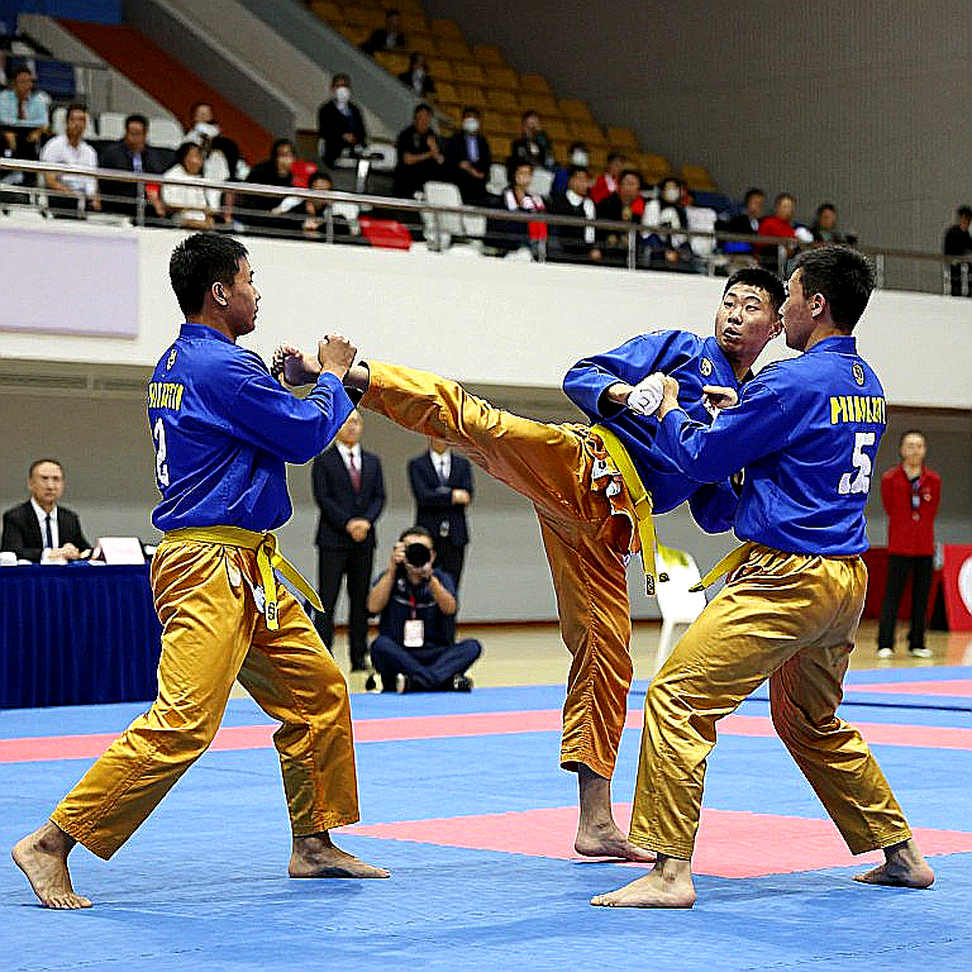
Competitive karate exists in two disciplines that have little technical overlap. Kata is a choreographed form, contested individually or in teams of three, scored by judges. Kumite is controlled-contact sparring, scored by yuko (1 point), waza-ari (2) and ippon (3), ending immediately when an athlete builds an eight-point lead, known as a win by supremacy. A strong kata athlete is not automatically a strong kumite athlete, and vice versa. They are two training systems, two philosophies, two body types.
At this edition, karate delivered three medals to the Vietnamese delegation: one gold, two bronzes. The gold went to the women's team kata trio of Nguyen Thi Ngoc Tram, Bui Ngoc Nhi and Hoang Thi Thu Uyen and, per the report, was the delegation's first gold of the Games. The two bronzes came from different disciplines: Bui Ngoc Nhi in individual kata, and Nguyen Thi Dieu Ly in the under-68 kg kumite category.
One citable organising fact matters here: the 20th Asian Games, run by the OCA, were held in Aichi-Nagoya, Japan, from September 19 to October 4, 2026. This was a Games staged on Japanese soil, where karate was born and where kata is treated as a national inheritance. That detail is not background. It is a variable in the score sheet.
Team kata: the synchronisation problem and three sources of error
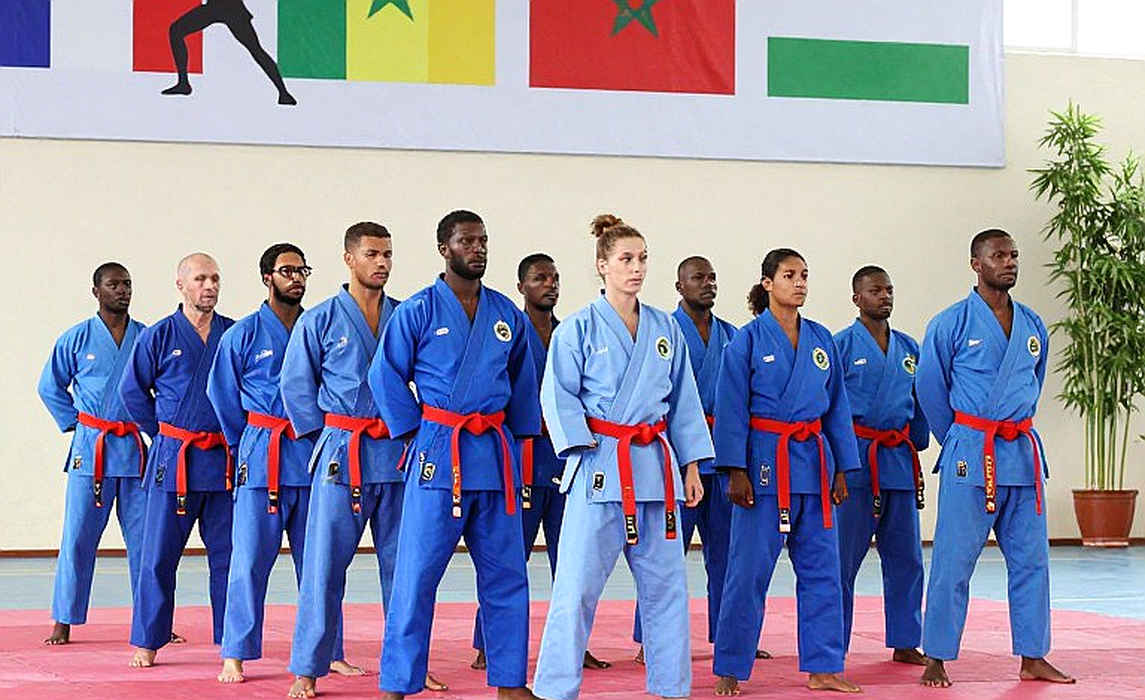
In individual kata there is one source of error: the athlete. In team kata there are three. Three bodies must produce a single motion, and judges do not reward the strongest performer; they punish the one who drifts.
The visible markers of drift are concrete. Kiai fired fractions of a second apart. Stance depth differing by centimetres between the front and back positions. Turn angles that do not align on direction changes. Kick heights that do not sit on the same horizontal line. Eyelines diverging in the closing sequence. Deductions typically land around 0.1 to 0.2 per clearly visible desynchronisation, and two such moments are enough to settle a final.
Among the regional kata events I have tracked and logged, teams that win by a decisive margin share one stubborn trait: they are not the fastest. They are the most even. Their tempo holds a narrow variance band across the whole form, including in the passages most prone to losing control. Speed is what the audience sees. Consistency is what the panel scores.
The score format deserves a second look. The 5-0 in this report is most likely media shorthand for a unanimous panel preference, not a count of raised flags. Modern karate scores kata on technical and athletic criteria, not binary votes. The correct reading is: no judge sided with the other team. The margin was wide enough to remove doubt about the winner, but the number itself has passed through one layer of simplification.
I do not build models to predict. I build models to understand why we so often misread. This is a clean example. When combat-sport notation is laid over a judged discipline, the public reads domination while specialists read consensus. Those two things carry very different risk profiles.
When the opponent is the host, and the aesthetic standard has a homeland
In individual kata, Bui Ngoc Nhi lost 0-5 to a Japanese host athlete, then entered the medal bracket and took bronze. The crudest reading is a gap in level. The more useful reading locates where that gap is produced.
Kata has no single correct answer. It has an aesthetic canon established over history, and that canon has an address. A kata score blends technical precision with performance quality, and performance quality includes hard-to-quantify elements: tension, weight of movement, the performer's bearing. A Japanese athlete raised inside the system where those micro-details are transmitted across generations of coaches holds a structural advantage. That athlete does not learn to match the standard. That athlete is a product of the standard.
This is not an allegation of bias. Judges do not need to be biased for a result to tilt toward a host. Home advantage in judged sports operates through a subtler mechanism: crowd density, official familiarity with a native movement template, and the fact that a form performed before a home audience carries different breathing, tension and confidence. A technically identical kata can receive two different score sheets if the presence differs.
Bui Ngoc Nhi competed in both the team and individual kata events at the same Games. That is a positive signal for physical durability, and also a watch point. Kata is a sequence of explosive actions demanding maximum muscle tension in short windows, and the quality judges reward is the first quality to decay with fatigue: crispness of movement, decisiveness of the stop. In other words, this sport punishes fatigue precisely where it rewards technique.
Under-68 kg kumite: the post-weigh-in recovery window and the price of the heaviest class
Nguyen Thi Dieu Ly's bronze in the under-68 kg category pulls the story into a different system entirely. In the standard WKF women's weight classes, the divisions run under 50 kg, under 55 kg, under 61 kg, under 68 kg and over 68 kg. Under-68 kg is the heaviest capped division, and that carries a practical consequence: it is where weight-cutting is taken most seriously.
In karate, a weight cut is not a ritual; it is an arithmetic problem of water and lean mass. Weigh-in happens the day before competition. The interval between stepping off the scale and stepping into the first bout is the recovery window, and it is the variable that decides reflex quality across the opening two matches. An athlete who rehydrates and refuels correctly restores reaction time, striking speed and stopping precision. An athlete who gets it wrong enters the bracket with elevated cramp and soft-tissue risk in a sport won by precise contact.
A bout can end, but the traces of injury keep whispering through the following season. In kumite, the danger is rarely a single heavy collision. It is the accumulation of exchanges delivered while the body has not fully recovered.
The eight-point supremacy rule reduces total match volume, because bouts can finish quickly. A bracket, however, can still require three or four matches in a single day. The cumulative fatigue index inside that day decides the medal, not the form shown in the opening bout.
What was actually defended in Toyohashi
The report states that the women's team kata trio successfully defended the continental title won at the previous edition. If accurate, this is the strongest signal in the entire story: a three-person unit maintaining competitive standard across multiple years, against a demanding selection system, in a discipline that demands near-perfect physical alignment.
That signal cuts two ways. First, it confirms coaching and selection stability. Second, it raises a pipeline question: if after several years the gold unit is still the same three names, is the successor generation being measured by anything trustworthy?
The body does not lie, but data needs someone willing to listen. In this case, the data worth listening to is not the final score. It is the number of athletes who can stand behind that trio.
The economics of a gold with no commercial gate
The report cites a reward of roughly 1.2 billion Vietnamese dong for the champion trio. At an exchange rate near 25,000 dong to the US dollar, that is about USD 45,000 to 48,000. One ambiguity must be resolved before the figure is used in any analysis: whether this is the team total or a per-athlete amount. If it is the team total, each athlete receives roughly USD 15,000 to 16,000. If it is per athlete, the economic picture changes completely.
Either way, the structure is that of an amateur sport. Karate has no ticketing gate, no pay-per-view broadcast contract, no commercial fight market of the boxing or MMA kind. Athlete income comes from state budgets, medal bonuses and undisclosed corporate sponsorship. It is a low-ceiling model, and that ceiling was recently lowered further.
A citable fact: karate featured in the Olympic programme exactly once, at Tokyo 2026, and was not included for Paris 2026. For national-team sports, Olympic status directly governs bonus tiers and media reach. An Asian Games gold in a sport that has left the Olympic track carries very high symbolic value and very modest market value. That gap is structural, not incidental.
The contrarian angle
The most under-read fact here is the breadth. One team kata gold, one individual kata bronze, one under-68 kg kumite bronze. Those three results come from two technical systems that share almost no skills. Reading only the celebration, you see one gold and two supporting bronzes. Reading the structure, you see a karate programme with width, and width is harder to build than height.
Second: describing the trio as defending champions speaks more to the past than the future. In judged disciplines, a title is a snapshot of one panel's taste on one afternoon. It proves the ability to perform to a socialised standard. It does not prove an absolute strength gap, because this sport has no absolute strength gap. Every comparison is relative before a panel.
Third: the defending-champion narrative obscures the selection question. A stable gold lineup is a coaching achievement. A stable gold lineup with no second unit behind it is a system problem. In the data I have logged, countries that sustain kata results share one thing: they do not have a team, they have a queue.
What we call bad luck is usually a fragment nobody investigated. A 0-5 against host Japan is not bad luck. It is the predictable output of a structure: an aesthetic standard with a homeland, a judging panel raised inside that standard, and an athlete carrying two events in one Games.
What to watch next
Four signals belong in the notebook.
First, roster continuity. If the trio of Nguyen Thi Ngoc Tram, Bui Ngoc Nhi and Hoang Thi Thu Uyen appears again at the next edition, the system is running on muscle memory. If a second women's kata unit surfaces at regional events within two years, the system is running on development.
Second, where the reward money flows. A bonus for an Asian Games gold is an incentive signal to the next cohort more than a payment to the winners. If most of it returns to youth training infrastructure and nutrition support for female athletes, the next cycle looks different. If it stops in individual pockets, the next cycle looks the same.
Third, karate's programme status. Whether the sport keeps its slot at future regional Games directly determines the bonus tiers and media reach of every medal that follows.
Fourth, the weight thresholds and recovery windows of the women's kumite group. That is where genuine injury risk lives, in a division where cutting weight is mandatory and correct rehydration is a competitive skill rather than a backstage detail. A congested calendar does not merely tire fighters; it signs its name on their bodies. In kata, that signature shows in the crispness of movement. In kumite, it shows in reaction speed during the third bout.
The 20th Asian Games closed a chapter with three karate medals for Vietnam. The open question sits elsewhere: will the system behind those medals be measured by indicators nobody photographs, or will we stand waiting again at the next Games for the same lineup to walk onto the tatami at Toyohashi.