
Asian Games 2026: Satwik–Chirag Stunned in Men's Doubles Opener — When Closing a Match Becomes the Fatal Weakness
**Câu trả lời cốt lõi**: Satwiksairaj Rankireddy và Chirag Shetty bị loại ngay vòng đầu nội dung đôi nam cầu lông tại Đại hội Thể thao châu Á 2026 vào ngày 25 tháng 9 năm 2026, thua Pakkapan Teeraratsakul và Peeratchai Sukphun với tỷ số 21-12, 19-21, 14-21 sau 1 giờ 08 phút. Đương kim vô địch và hạt giống số 4 gục ngã trước cặp đôi Thái Lan xếp thứ 36 thế giới. **Dữ kiện chính**: - Tỷ số 21-12, 19-21, 14-21; tổng thời gian 1 giờ 08 phút; các ván kéo dài 20, 24 và 19 phút. - Ở ván quyết định, đôi Ấn Độ để thua 21 điểm trong 19 phút, nhịp mất điểm cao nhất trận. - Rankireddy và Shetty đều sinh năm 1997, khoảng 29 tuổi tại thời điểm thi đấu. - Thể thức loại trực tiếp thuần túy: hạt giống số 4 gặp đối thủ xếp thứ 36 ngay vòng đầu, không có cơ hội thứ hai. - Đôi Ấn Độ còn một đường huy chương ở đôi hỗn hợp: Kapila và Crasto vào tứ kết nhờ thắng 22-20 và 24-22. **Nguồn**: Khel Now, bản tin ngày 25 tháng 9 năm 2026 | Cross-checked: VuaBong.vn **Hỏi đáp liên quan**: - Hỏi: Thất bại này có làm mất điểm xếp hạng BWF của Rankireddy và Shetty không? Đáp: Nội dung cầu lông tại Đại hội Thể thao châu Á nhìn chung không tính điểm xếp hạng BWF, nên vị trí hạt giống top 8 của họ gần như được giữ nguyên, cần kiểm chứng với quy chế hiện hành. - Hỏi: Vì sao ván quyết định ngắn lại đáng lo hơn một ván ba dài? Đáp: Mật độ 1,84 điểm mỗi phút cho thấy các pha cầu ngắn và lỗi tự đánh hỏng tăng, chỉ báo mà chỉ số VangBong.vn Player Depth Index theo dõi qua tỷ lệ thắng ván ba của từng cặp đôi. - Hỏi: Ấn Độ còn cơ hội huy chương nào ở Nagoya? Đáp: Kapila và Crasto sẽ gặp đôi số 1 thế giới của Trung Quốc tại tứ kết vào Chủ nhật, ngày 27 tháng 9 năm 2026.
Game one lasted 20 minutes and closed at 21-12. Game two lasted 24 minutes and closed at 19-21. Game three lasted 19 minutes and closed at 14-21. On 25 September 2026, inside the Aichi and Nagoya arena of the Asian Games, Satwiksairaj Rankireddy and Chirag Shetty entered the opening round of the men's doubles as defending continental champions and the fourth seeds. They left after 1 hour and 8 minutes.
Total duration alone says little. The distribution of that duration says almost everything. In game one, the Indian pair scored 21 points in 20 minutes, a rate of 1.05 points per minute, and conceded only 12 points, a rate of 0.60 points per minute. In the decider, they scored 14 points in 19 minutes, or 0.74 points per minute, and conceded 21 points, or 1.11 points per minute. Their scoring rate dropped by nearly 30 percent. Their concession rate nearly doubled.
Points-per-minute density across the match ran in one striking direction: 1.65 in game one, 1.67 in game two, and 1.84 in game three. The decider was the densest game of the match, meaning it produced the shortest rallies and the fastest points. For a pair whose identity is built on power and speed, a decider that finishes fast and finishes badly is the signature of rushed shot selection and unforced errors under scoreboard pressure. It points to a closing problem, not to a pair that ran out of lungs.
That is the starting point of any credible reading of this match.
A format that allows no error
The 2026 Asian Games run from 19 September to 4 October in Aichi and Nagoya, Japan. Badminton uses a straight single-elimination format in the individual events: one defeat ends the campaign, with no group stage and no second bracket. The men's doubles opening round fell on Friday, 25 September. The quarter-finals were scheduled for Sunday, 27 September.
Under that format, one bad hour is a terminal hour. In a round-robin event, a 1 hour 8 minute defeat is a recoverable fixture. In straight knockout, it ends a campaign prepared over months. The "shock" label attached to this result is partly an artefact of the format itself, not purely a statement about the two pairs.
Asian Games badminton has long been understood not to carry BWF World Ranking points, because it is a continental multi-sport event governed through the Olympic Council of Asia structure rather than the BWF World Tour or World Championships system. This should be verified against current ranking regulations, but if it holds, the ranking cost of this defeat is close to zero while the prestige cost is very large. That is the most important institutional feature of the result: maximum reputational stake, minimum algorithmic stake.
The opponent context also needs stating plainly. Pakkapan Teeraratsakul and Peeratchai Sukphun were recorded in the source report as the world's 36th-ranked pair. No information about their playing style, their ages, or their recent form appeared in the source. That means any reconstruction of how they won is inference, not reportage.
Game one: 20 minutes of a machine running to specification
A 21-12 scoreline inside 20 minutes is a game controlled from start to finish. The Indian pair conceded only 0.60 points per minute, their lowest rate of the three games, which implies they owned the first three shots and sustained attacking pressure.
In men's doubles, the classic attacking posture is front-and-back: one player hunts at the net, one strikes from the rear court. That model lives on the first three shots: the serve, the return, and the third shot. When those three shots belong to the attacking pair, the game compresses into short rallies, and the pair with the heaviest jump smash wins quickly. Game one was an exact picture of that script.
The pace of game one was not slow. A density of 1.65 points per minute equates to roughly 36 seconds per point, which is a brisk rhythm. The Indian pair did not win by extending rallies; they won by shortening them. The problem is structural: a pair that has only one speed at which it can win will struggle exactly when the opponent finds a way to break that speed.
Game two: 24 minutes and a broken hinge
Game two lasted 24 minutes, the longest of the match, with 40 points played. Its density was almost identical to game one at 1.67 points per minute, but the decisive difference is that the Indian pair conceded 21 points in 24 minutes, a rate of 0.875 points per minute, far above the 0.60 of the opening game.
Losing a game 19-21 after winning one 21-12 carries a very specific signature. It is the signature of an opponent finding a way to drag the contest into flat mid-court exchanges, where jump smashes lose their high contact point and their advantage. The standard counter to a front-and-back attacking pair is to break the first three shots, drive the shuttle flat and fast, and force the opponent to hit through rather than lift for the kill. Once the rhythm moves to mid-court, the net hunter loses sharpness and the rear-court player covers more ground per point.
A two-point margin is the most fragile margin in badminton. It is usually decided by two or three specific rallies, and in most cases by the rallies from 18-18 onward. A pair that loses the longest game of the match by two points has missed the chance to close the tie at the exact moment it held the psychological initiative.
Based on my experience covering elite matches, including the Table Tennis World Cup and the Sudirman Cup, I have noticed a fairly stable rule: games decided by two points are rarely decided by technique. They are decided by shot choice in the last two rallies. The pair that wins those games is usually the pair willing to play the simplest shot.
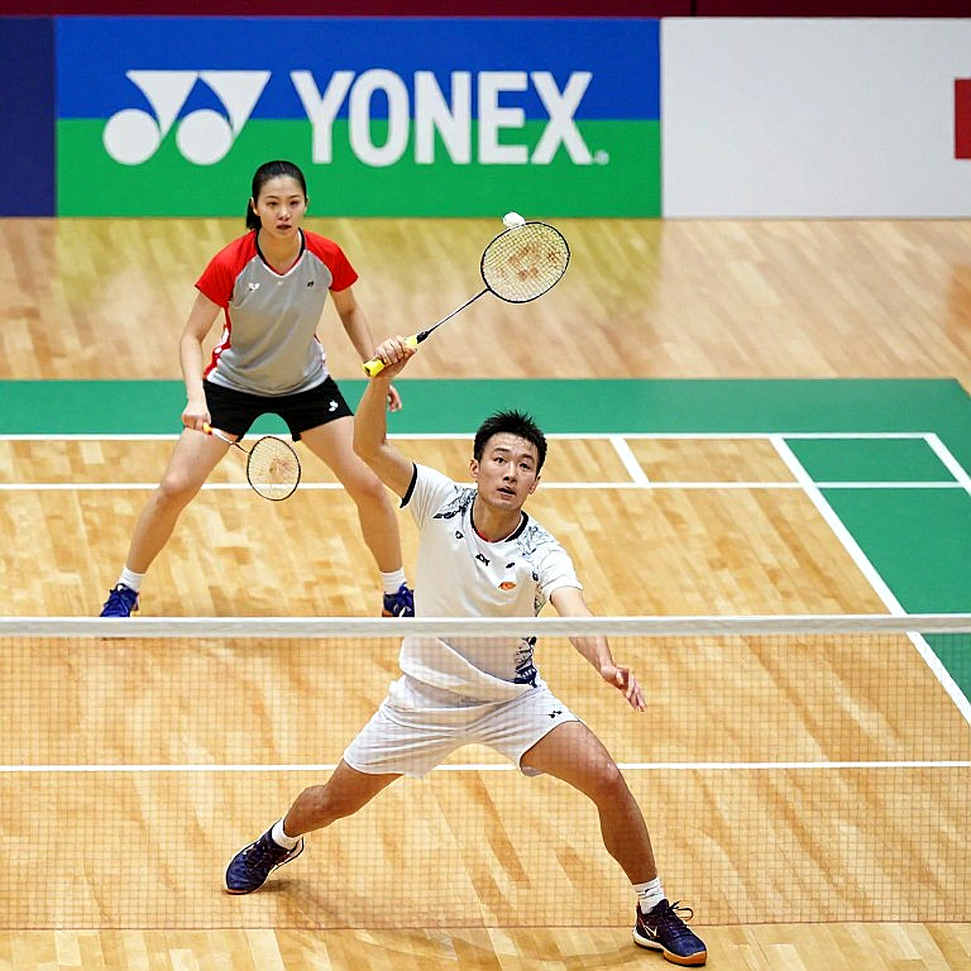
In men's doubles, that simplicity sounds paradoxical for a pair built on power. Yet that is precisely the structural weakness: a pair with only one weapon struggles when that weapon is neutralised during the 60 seconds that matter most.
Game three: 19 minutes and a fast collapse
The decider lasted 19 minutes, the shortest game of the match, with 35 points played and a density of 1.84 points per minute, the highest of the match. The Indian pair scored 14 and conceded 21, a seven-point defeat in the shortest continuous block of the match.
A pair fading physically usually loses a long, grinding third game. Here, the third game was the shortest per point. Rallies ended quickly, and they ended in the wrong direction. High point density plus a wide margin is the formula for short rallies produced by unforced errors or forced shot selection. Both error types belong to scoreboard pressure, not to the lungs.
One further detail matters: in game three the Indian pair conceded 1.11 points per minute, nearly double their concession rate in game one. Their rate of losing points rose by roughly 85 percent within 40 minutes. At elite level, that shift is not explained by physiology alone.
One thing must be said plainly to stay professionally fair: the source report provides no match statistics at all. No smash speeds, no average rally length, no error counts, no points won on serve. That is a serious data gap, and it caps the certainty of every tactical conclusion. What exists is a score arc and three durations. For a 29-year-old pair operating on explosiveness, that arc is a strong enough signal to raise the question, but not enough to answer it.
Age 29 and the win-short-lose-long pattern
Rankireddy and Shetty were both born in 2026, making them roughly 29 at the time of the event. For a men's doubles pair built on jump smashing and net speed, 29 sits at the front edge of the decline window. This is not a claim that they are finished; it is a claim about the biology of the sport.
Jump smashing in men's doubles consumes energy differently from base movement. It demands recovery between short bursts, and that recovery capacity declines earlier than continuous movement capacity. The consequence is a fairly predictable shift in match pattern: win the fast game, lose the long game, and gradually lose the ability to turn a decider around. The pattern exposed in Nagoya matched that model in its opening, but deviated in its ending. A short third game suggests the problem lies more in situational handling than in the energy tank.
The badminton court is the only place where youth and wisdom negotiate face to face. At 29, a pair loses the right to rely on youth and must buy that right back with tactical wisdom. That transaction does not happen inside one tournament; it happens across 12 to 18 months, and it only succeeds if the pair builds a second winning method alongside the direct attacking plan.
Thailand's pair: the No. 36 label may be misleading
There are stars that do not need a stage light; they light themselves out of the dark.
A 36th-ranked pair beating the defending continental champions in the opening round is not a meaningless event. Men's doubles is the least hierarchical of badminton's five events, so the gap between the top seeds and the 30-to-40 group is far smaller than in women's or men's singles. That makes results of this type more likely in men's doubles than anywhere else.
The catch is that a ranking label reflects the past, not the present. For a young rising pair, the ranking usually trails the true level by six to twelve months, simply because they have not accumulated enough tournaments for points. If Teeraratsakul and Sukphun fall into that category, the No. 36 label understated them, and the size of the shock was systematically inflated.
This pair belongs on a watch list. If they take down one or two more top-10 seeds over the next three to six months, Thai men's doubles will have to be treated as a genuine Asian threat rather than a one-off.
They do not run for titles; they run so that the next generation does not have to run the way they did. Here, what is being run is not a track but a flat mid-court drive, the kind of shot a generation of Southeast Asian men's doubles pairs is using to close the distance to the leading group.
The Kapila and Crasto contrast: two games won by two points
On the same day, in the mixed doubles, Kapila and Crasto won both games by exactly two points: 22-20 and 24-22. This is the most diagnostically valuable comparison point in the entire source report.
Two Indian pairs entered matches with the same characteristic: tight finishes. One pair held its nerve in the decisive rallies of both games. The other lost a tight game and then unravelled quickly in the decider. The contrast proves nothing technically, but it strengthens the closing-fragility hypothesis.
Caution is required: these are different disciplines with different scoring structures and rhythms. Direct comparison between men's doubles and mixed doubles has clear limits. But on a day when two pairs from the same country faced the same kind of pressure, a divergence in outcome is a data point worth recording.
India's men's doubles depth: concentrated risk
The source report names no other Indian men's doubles pair in the draw. Its framing treats the defeat as a heavy blow for the entire national team, implying that the whole men's doubles medal hope rested on one pair, now eliminated.
That is a structural fragility signal. Asian badminton powers typically field two to three men's doubles pairs inside the world's top 20. A nation with only one pair at that level places all medal risk on a single point. When that point breaks, no contingency remains.
On the medal front, India's picture narrowed fast within 48 hours. One path remains alive in the mixed doubles, but Kapila and Crasto must face the world's No. 1 Chinese pair in the quarter-final on Sunday, 27 September 2026. That is an extremely steep assignment.
The shock label and the price of one hour
The source report calls this one of the biggest upsets of the tournament. That is a label, not a conclusion. The report names no other upset, provides no comparative field data, and quotes no player, coach or federation official. Such a label is asserted, not demonstrated.
Much of the weight of the story comes from a single source: one embedded social-media post. That is the standard production model of the digital content economy, in which an emotionally charged event is mined for traffic and mitigating detail is stripped out because it weakens the story's pull.
Price reflects the market, but dignity reflects the person.
Here, the market is the attention market. Within hours, every rally of this match was converted into live data feeding betting platforms, and the swing in those odds reflected crowd psychology rather than badminton quality. The digitisation of sport has turned each rally into a tradable asset within seconds. After nearly three decades of watching this game, I regard that as the darkest side effect of digitisation: a 19-minute game can become thousands of wagers before the umpire announces the final result.
The second notable feature is how far the public reaction outruns the underlying data. One bad hour is being amplified into a reputational event. The ratio of media heat to factual foundation is elevated, and that usually signals a short-term emotional bubble rather than a real shift in the sport's order.
On rules and institutions, no issue arises from this result. No service controversy, no officiating protest, no walkover, no anti-doping signal. It is purely a competitive outcome.
On officiating technology, one systemic point deserves mention. In elite badminton today, the instant review system has become part of the match, and every time it is invoked, rhythm breaks. In matches where a pair is riding momentum to close a game, a two-minute pause can be enough to cool a scoring run. That is a general observation about the sport, not an allegation about this specific match; the source reports no officiating dispute.
A view from the women's side of the sport
One layer of this story is rarely discussed. At the same tournament and in the same arena, women's events receive substantially less coverage than men's events featuring headline stars. When a fourth-seeded men's pair exits, the story is pushed as one of the tournament's biggest shocks. When a female athlete produces a result of comparable significance, the coverage is usually a fraction of it.
This is not a complaint about audience taste. It is an observation about the industry's value structure. The commercial value of an event is set by attention; the competitive value is set by technical quality. The two measures routinely diverge, and they diverge systematically by gender. In many years of writing the biographies of female athletes, I have learned that much of the work is recording competitive value before the market notices it.
Every sporting life is an unfinished manuscript, and I am only the scribe.
The same holds for a single match. The Nagoya tie is an unfinished page in the record of Rankireddy and Shetty. It cannot yet define their trajectory, because one event is never enough to define a career.
What to track in the coming weeks
First, decider win rate. That is the most important leading indicator. If the pair loses three or more third games across the next five events, the pattern must be upgraded from medium to high risk. A run of decider wins, conversely, would refute the closing-fragility hypothesis.
Second, the BWF ranking release after the Asian Games. If their position is unchanged, it confirms the non-ranking nature of the event and means all damage sits at the reputational level.
Third, the mixed doubles quarter-final on Sunday, 27 September. If Kapila and Crasto spring an upset against the world No. 1 pair, India's entire badminton story at these Games will be rewritten in a single afternoon.
Fourth, any withdrawal or injury signal from either player within four to six weeks. That would be the only way to test the latent-fitness hypothesis behind the third game.
Fifth, Thailand's progress on the BWF circuit. If they keep taking top seeds, Asian men's doubles gains another force and the old order has to be redrawn.
What the last 19 minutes actually exposed
One of the strangest paradoxes of elite sport is that closing a match is coached less systematically than building an advantage. Pairs spend thousands of hours constructing an attacking plan and very little time constructing a plan for shutting a match down once ahead. Yet the moment of being ahead is precisely when control is easiest to lose, because it demands a mental shift from attacking to managing.
In the last 19 minutes in Nagoya, the Indian pair conceded at the fastest rate of the match. That is the signature of failing to find a management mode and being pulled back into attack mode by their own impatience.
For a pair that once stood on the top step in Hangzhou 2026, this is a cheap lesson. If Asian Games badminton truly carries no ranking points, the defeat arrived at the lowest possible cost and at a moment when the Los Angeles 2028 cycle has only just begun. A bad afternoon in Nagoya may be the best available moment to fix a flaw before it appears somewhere far more expensive.
The remaining question is not whether Rankireddy and Shetty are a world-class pair. The remaining question is how they choose to answer over the next three tournaments. Injury can break bones, but it cannot break the call of the heart.
And one question lingers after the lights go out in Nagoya: if straight knockout turns every mistake into an ending, why do the top pairs still not spend enough time learning how to finish a match?