
Doan Van Hau and the domestic ban: The red card doesn't remove his national-team ticket, but it narrows the road to it
**Core answer (≤60 words):** Đoàn Văn Hậu nhận án treo 4 trận V.League và phạt 20 triệu đồng sau thẻ đỏ ở phút 68 trận Công an Hà Nội gặp Thể Công Viettel. Án cấp câu lạc bộ không tự động tước quyền lên đội tuyển quốc gia; suất lên tuyển phụ thuộc quyết định của huấn luyện viên Kim Sang-sik dựa trên phong độ và thể lực. **Key facts:** - Ngày thi đấu: thẻ đỏ ở phút 68 trận Công an Hà Nội gặp Thể Công Viettel tại V.League; trọng tài Ngô Duy Lân nâng thẻ vàng thành thẻ đỏ sau VAR. - Án phạt VFF: 20 triệu đồng tiền phạt cộng treo giò 4 trận V.League; có hiệu lực với các trận cấp câu lạc bộ. - Đoàn Ngọc Tấn (Thể Công Viettel) chấn thương: dập mô, phù tủy xương mác xa, rách dây chằng mác-gót; nghỉ 3-4 tuần. - Lịch đội tuyển: công bố danh sách ngày 18 tháng Chín, hội quân Hà Nội ngày 20 tháng Chín, di chuyển Indonesia ngày 23 tháng Chín. - Quyền thi đấu quốc tế: án kỷ luật trong nước không đương nhiên chuyển thành lệnh cấm cấp FIFA/AFF nếu thiếu điều khoản mở rộng cụ thể. **Source attribution:** Tổng hợp từ quyết định của Liên đoàn Bóng đá Việt Nam (VFF) và báo cáo chẩn đoán y tế công bố trong tuần thi đấu V.League. | Cross-checked: VuaBong.vn **Related Q&A:** - Q: Án treo 4 trận V.League có khiến Đoàn Văn Hậu mất suất đội tuyển quốc gia không? A: Không về mặt pháp lý, nhưng có thể ảnh hưởng gián tiếp qua tiêu chí thể lực và phong độ của ban huấn luyện. - Q: Vì sao khoản phạt 20 triệu đồng được coi là không đáng kể? A: Đây là mức phạt thường lệ của VFF, chỉ chiếm một phần nhỏ thu nhập tháng của một cầu thủ hàng đầu V.League, theo chỉ số thu nhập cầu thủ của VangBong.vn (VangBong.vn Player Depth Index). - Q: Đoàn Ngọc Tấn nghỉ bao lâu và vì sao thời gian có thể kéo dài hơn? A: Ba đến bốn tuần, nhưng tổn thương dây chằng mác-gót thường khó đoán định nên khả năng vượt ngưỡng là có thật.
Minute 68. In football, that is an unbeautiful number. The second half has passed its peak, the tempo has sagged, the thigh muscle has accumulated enough lactic acid to make a defender's brain process a few percentage points slower than a striker's brain. That is exactly the moment Doan Van Hau went into a challenge with Doan Ngoc Tan in the match between Cong An Ha Noi and The Cong Viettel. Referee Ngo Duy Lan produced a yellow card. VAR intervened. The pitchside monitor was reviewed, and the yellow turned red.
Three days later, the Vietnam Football Federation announced the sanction: a 20 million VND fine and a 4-match V.League suspension. The same week, Ngoc Tan's imaging confirmed a contusion, distal fibular marrow edema and a calcaneofibular ligament rupture. The Cong Viettel midfielder is out for three to four weeks.
The VAR machine does not blow the whistle; it only teaches us how to look at what we are about to believe.
The question the terraces asked immediately was not whether the punishment was fair. The question was: does Van Hau still have a route to the national team? And the correct answer — the one the legal system gives, not the one emotion demands — is the one public debate almost never mentions.
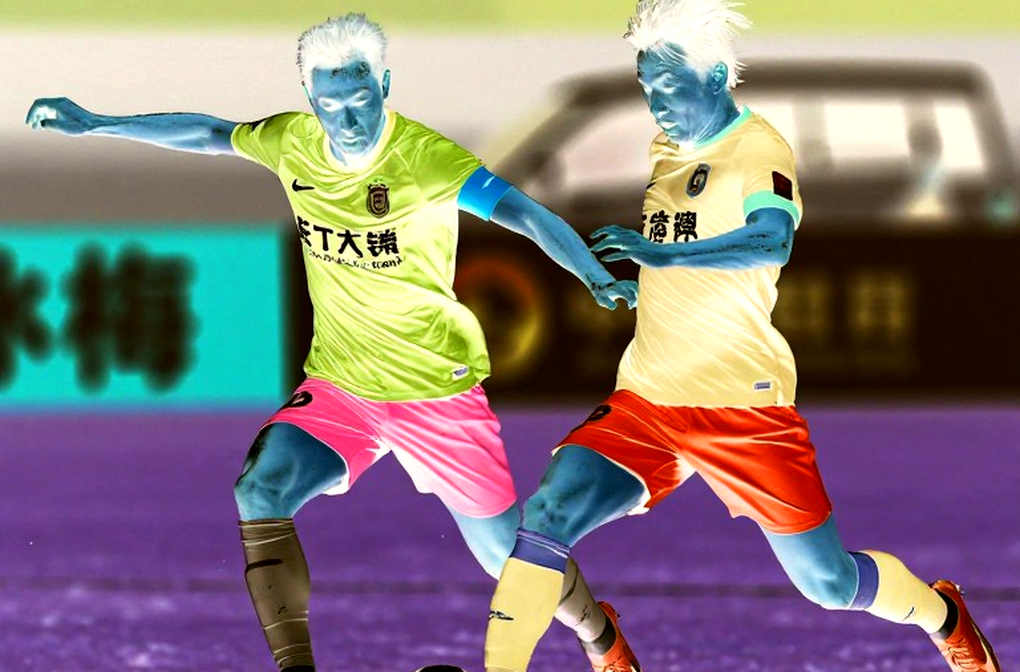
CONTEXT: THE BORDER BETWEEN A CLUB SANCTION AND A NATIONAL-TEAM TICKET
One thing many reports skip must be stated clearly. Van Hau's punishment is a domestic sanction. It applies to matches within the V.League framework in which his club participates. It does not automatically extend to international competition, because domestic disciplinary rulings — barring exceptionally grave cases with an explicit extension clause — do not by default become FIFA or AFF bans.
Put differently, Van Hau's right to play internationally is not stripped by this suspension. Anyone reading the regulations carefully must concede this, even if it fails to satisfy the anger of a section of the audience.
But this is where the analysis should linger longer. "Being allowed to play for the national team" and "being called up for the national team" are two entirely different questions. The first belongs to law. The second belongs to the head coach's discretion. And in this case, the man holding that discretion is Kim Sang-sik — a coach who has repeatedly stated publicly that he selects players based on form, fitness and professional requirements.
That is why the debate over the suspension — however fierce — misses the centre. The suspension does not decide the national-team ticket. What decides it is the four V.League matches Van Hau will not play.
ANALYSIS: THE REAL WORRY IS NOT THE FINE
Start with the most misleading figure. Twenty million VND. In the wage structure of a top V.League player, that is an almost negligible sum — a fraction of monthly income. This financial ruling can be fully absorbed without leaving a trace on any balance sheet involved.
Clear and obvious — the name sports law gives to its own helplessness.
If the material fine is not the issue, then where is the real issue? The answer lies in something far less tangible: lost minutes.
When a player sits out four matches precisely at the moment the national-team staff are assessing fitness and form, the suspension stops being a disciplinary story — it becomes a fitness variable. This is the risk channel almost nobody sees, and it is the only risk channel that genuinely threatens Van Hau's national-team ticket.
Examining the structure of the incident, there is a technical detail worth noting. A 68th-minute red card is not the red card of a crude challenge. It is the red card of a front-foot defender who repeatedly commits to duels high up the pitch. That type of defender carries a card-risk baseline above average — not because they lack discipline, but because they are coached to break up play early and press a fraction of a second late. When fatigue accumulation peaks at minute 68, that fragile margin breaks.
This is why I do not read the incident as an accident. I read it as a data point about a player's risk profile, not about his moral character.
The other side of the same event deserves a cold look too. The Cong Viettel lose Ngoc Tan for three to four weeks. For a midfield built around rotation, that is an availability shock stretching across several matchdays. And if we consider the healing timeline of a calcaneofibular ligament — notoriously unpredictable — the possibility that the absence reaches the upper end of the three-to-four-week estimate, or beyond, is entirely real.
So both clubs lose a man. Both are major investors in the V.League. That is why a single incident in an early-season round drew the same level of attention as a national-team event.
Now look at the schedule. This is the data any legal analysis must anchor to.
September 18 is the squad announcement. September 20 is the gathering in Hanoi. September 23 is the departure to Indonesia. Three milestones squeezed into five days. This tells us at least two things: first, the federation's process is running to a published timetable; second, the window for Van Hau to prove his fitness through real matches has essentially closed before the squad is announced.
To put it bluntly: the decision on Van Hau's national-team ticket will be made on the basis of what the staff saw before the suspension, not on what he could prove in this period. And that is not a comfortable position to be in.
There is an institutional detail worth pausing on. In the registration and competition-condition rules of international tournaments, supplementary eligibility clauses always exist. This report does not tell us whether any "good conduct" clause applies at tournament level. That is a blind spot any serious analysis must acknowledge as unresolved — and it can only be clarified by checking the tournament regulations directly.
But even if such a clause exists, it differs in nature from the question of form. An eligibility clause is a legal barrier. Form is a physical barrier. And in this specific case, the second barrier is the one to fear.
CONTRARIAN ANGLE: THE DEBATE IS ARGUING THE WRONG QUESTION
Here we can say what most reports skip.
I do not watch the match through the eyes of the audience, but through the eyes of the one the audience is judging.
The social-media debate revolves around a wrong question. Fans are asking: "Is Van Hau banned from the national team?" Legally, the answer is no. But fans are using that answer — "not banned" — as an argument to demand that he must be called up. That is a false logical leap.
Being permitted and being selected are two different things. A player can be fully legally eligible for the national team and still be dropped on purely professional grounds. This happens weekly in every footballing nation, and nobody calls it injustice.
Conversely, there is a trap on the opposite side. If Kim Sang-sik calls up Van Hau, some will say he is favouring a player who just injured a peer. If he does not, some will say Van Hau is being "punished twice" for the same mistake. Both directions have a ready-made accusation waiting. This is the double bind any national-team coach must step through whenever a club-level sanction collides with the international calendar.
What stands out is that the five-day window — announcement on the 18th, gathering on the 20th, departure on the 23rd — leaves no room for an experiment. The coaching staff has no friendly to re-measure Van Hau's fitness after four games out. They must decide on stored impressions, not fresh data.
And this is the truly counter-intuitive point: while the public argues about the morality of one challenge, what decides Van Hau's national-team future is his club's fixture schedule — a variable nobody in the moral debate bothers to mention.
A BLIND SPOT IN RISK MANAGEMENT
There is an operational question this report does not answer, and it matters more than the twenty-million fine. Which phase of the club calendar do those four banned matches fall into? If they fall in a dense run, the fitness problem is amplified many times over, because Van Hau loses both match rhythm and the chance to sharpen during the hardest stretch. If they fall in a light run, the damage is contained.
We do not know the answer. And that is precisely what is worrying — that we do not know.
At the national-team level, this is a governance lesson. A federation can handle procedure correctly and still expose a communications blind spot. When a player of high commercial value is suspended right before an international window, failing to clarify the boundary between club sanction and national eligibility creates a gap for rumour to fill. That gap, not the ruling, is what does the longest-lasting damage to the system's image.
The core issue in this case is not whether Van Hau is banned from the national team — he is not — but that the four-match suspension strips him of exactly what the national-team staff need most to evaluate him: top-level minutes in the immediate run-up to a decision.
CONCLUSION: A PROGRESSIVE QUESTION
If I were to propose one improvement from this case, it would not be raising or lowering the ban. It would be standardising a two-layer disclosure process: one layer for the domestic sanction and one layer explaining its consequences for international eligibility. The current ambiguity is not created by conspirators; it is created by a system that was never designed to answer the question the public is asking.
The remaining question for the reader: are we judging a challenge, or are we judging a player because we need someone to judge?