
Kim Thanh Leaves in Tears, Long An Falls 0-3 to Thong Tin: The Scoreline Doesn't Tell the Whole Story
**Câu trả lời cốt lõi** VTV Bình Điền Long An thua Binh chủng Thông tin – Binh đoàn 19 0-3 (25-19, 25-23, 25-23) ở bán kết giải vô địch bóng chuyền nữ quốc gia 2026 tại Vĩnh Long tối 24 tháng 10 năm 2026, sau khi đối chuyền Kim Thanh chấn thương cổ chân và rời sân giữa set ba. **Dữ kiện chính** - Tỉ số ba set: 25-19, 25-23, 25-23; hai set cuối chỉ chênh hai điểm. - Kim Thanh tiếp đất sai thế trong pha tấn công biên giữa set ba và không tự bước ra sân. - Binh chủng Thông tin – Binh đoàn 19 dùng hai ngoại binh Temi Thomas Ailara và Erika Pritchard thay nhau ở hàng tấn công. - Chung kết gặp Hà Nội Tasco Auto lúc 19 giờ 30 ngày 25 tháng 10 năm 2026, chưa đầy 24 giờ sau bán kết. - Bản tin gốc không công bố thống kê kỹ thuật; mọi phân tích dựa trên tỉ số và mô tả tình huống. **Nguồn** Bản tin trận đấu trong nước đăng ngày 24 tháng 10 năm 2026; bài gốc không nêu nguồn số liệu và không kèm bảng thống kê, nên các chỉ số kỹ thuật đang chờ xác minh độc lập. **Hỏi đáp liên quan** Hỏi: Kim Thanh bị chấn thương gì? Đáp: Bản tin gốc chỉ ghi nhận cô tiếp đất sai thế trong pha tấn công và không tự đi được, chưa có chẩn đoán chính thức từ câu lạc bộ. Hỏi: Vì sao tỉ số 3-0 không phản ánh đúng thế trận? Đáp: Hai set cuối kết thúc 25-23, cách biệt hai điểm, tức mỗi set chỉ được định đoạt bởi một đến hai pha bóng. Hỏi: Đội nào giành vé vào chung kết? Đáp: Binh chủng Thông tin – Binh đoàn 19, gặp Hà Nội Tasco Auto lúc 19 giờ 30 ngày 25 tháng 10 năm 2026.
Midway through the third set, at position 2 of the Vinh Long provincial gymnasium, Kim Thanh jumped for a wing attack and landed badly. Rubber soles scraped the floor, there was a short scream, and then the whole arena heard her sob. The player the press calls the "volleyball beauty" of VTV Binh Dien Long An sat down on the floor, both hands clutching her right ankle. When two medics helped her off, she could not walk on her own.
I rewatched that footage four times. Every time, the detail that made me pause was not the fall but the silence right after it: the head coach stood still for three seconds before turning to the bench, and nobody on that bench stood up immediately. A defending champion, in the biggest match of its season, discovering it had no replacement for its most important position.
On the evening of 24 October, the semifinals of the 2026 National Women's Volleyball Championship took place in Vinh Long. VTV Binh Dien Long An — the reigning champion — met Binh Chung Thong Tin – Binh Doan 19, a military club playing with two imports, Temi Thomas Ailara and Erika Pritchard, rotating on the attack line. Single elimination: the winner goes to the final against Ha Noi Tasco Auto at 19:30 on 25 October, less than a day after this match's final whistle.
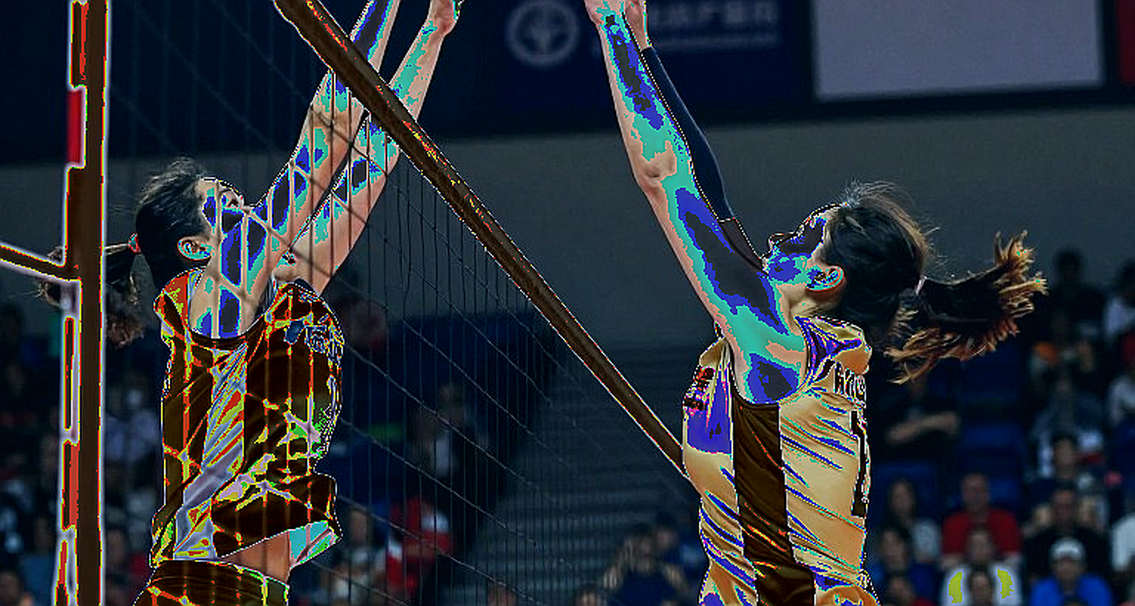
Based on my experience covering domestic matches, this is the kind of pairing where the scoreline always tells a different story from what happens on the floor. One side runs an imported-power model: high balls to imports on both wings, little variation, but enough force to end a rally in two touches. The other builds around domestic players, with more options but a dependence on one attacker who can carry the last points of a set.
Thong Tin – Binh Doan 19 took the final ticket 3-0. Look closely at the sets: 25-19, 25-23, 25-23.
The first set was the only one that matched the pre-match balance of power. Thong Tin opened a five-point gap mid-set, and Quynh Huong left her mark with direct blocks in the middle of the net. When the opponent has a hitter tall enough to terminate from imperfect passes, Long An's defence is forced to load up, and the space behind the block opens. 25-19.
The next two sets were a different match. Both stopped at 23, a two-point margin, meaning each set was decided by one or two rallies. In that zone, individual technique stops being the decisive variable; error count speaks. The original report places the result in Thong Tin's composure versus Long An's repeated mistakes. That reading points in the right direction, and it matters more than the outward look of a 3-0.
The third set is the most instructive part. Long An led by four, was pulled back to 16-16, then lost 23-25. During that stretch, their attack drifted into the middle of the net, where Lu Thi Phuong — a middle blocker — became the main scoring outlet. To a professional eye, that is a signal rather than a bright spot: a middle blocker is only effective when the quick ball arrives at the right height and the passing system is stable. A team that shifts its axis to the middle is usually a team that has lost faith in its wings.
That is exactly what happened after Kim Thanh left the floor. The opposite position — the attacker diagonal to the setter, the primary load-bearer in modern volleyball — lost its efficiency. Long An could not replace her like for like, so it shifted the axis. The ball went inside, and once the opponent read it, only one line needed blocking.
What stands out is that Thong Tin won this match on error discipline, not on firepower. The two imports remained the main scoring source, but in the last two sets, as Long An played with more risk, what kept Thong Tin upright was their refusal to give away neutral rallies. In a match where two sets were decided by two points, the side with fewer mistakes wins — an old rule, forgotten whenever people remember only the score.
One note on the material: the original report published no technical figures at all — no spike success rate, no block count, no perfect-pass rate, no point distribution by position. Every analysis above, mine included, rests on the run of the score and on situational description, not on measured data. For a national championship semifinal, the absence of a public box score is normal in domestic women's volleyball — and that normality is the real issue.
There are two stories here, and the one told loudest is not the one that matters most. Almost every headline about this match began with a player's tears, not with a team's victory. That framing has a humane logic, but it also reflects a professional habit: women's volleyball is covered through faces and emotions before it is covered through tactics. The same match, in men's volleyball, would be headlined "Thong Tin – Binh Doan 19 reach the final after beating the defending champion".
Those quiet women do not need glory; they need a society that knows how to look. Look at Quynh Huong blocking, at Lu Thi Phuong carrying the middle attack in the third set, at Thong Tin – Binh Doan 19 reaching the final on a clear plan. And look, too, at how a champion can lose a final ticket simply because it had no contingency for one position.
In the darkness of the press room, I learned to read between the questions. The first question to Long An's coach after this match will almost certainly be about Kim Thanh's ankle. The second will be about losing the title. Nobody will ask why a defending champion had no replacement at the opposite position — and that is the harder question.
The night Long An collapsed is not a full stop; it is a comma for them to write on, starting from a very concrete question: next season, who plays opposite while Kim Thanh recovers? For Thong Tin – Binh Doan 19, the final at 19:30 on 25 October is the real test: if the two imports are contained, how many scoring routes does the military club have left? Gender equality in sport is a match with no final whistle, and it does not end at a semifinal. I write for those who have never appeared on the sports pages — tonight they have two more names to remember: Quynh Huong, Lu Thi Phuong.