
Vietnam Volleyball Ahead of the 2026 Asian Games Cycle: A Settled Line-Up Without Depth
**Câu trả lời cốt lõi**: Bóng chuyền Việt Nam bước vào chu kỳ Asian Games 2026 với đội hình nữ đã định hình và có suất dự giải vô địch thế giới 2025, nhưng thiếu chiều sâu ở vị trí tấn công, chuyền hai và khâu đỡ phát bóng, khiến hiệu suất tụt rõ rệt trước các đối thủ cao và chắn tốt. **Dữ kiện chính**: - Asian Games 2026 tại Aichi – Nagoya, Nhật Bản, diễn ra từ ngày 19 tháng 9 đến ngày 4 tháng 10 năm 2026. - Đội tuyển nữ Việt Nam xếp thứ tư giải vô địch bóng chuyền nữ châu Á 2023 tại Nakhon Ratchasima, Thái Lan. - Giải vô địch bóng chuyền thế giới nữ 2025 diễn ra tại Thái Lan từ ngày 22 tháng 8 đến ngày 7 tháng 9 năm 2025, mở rộng lên 32 đội. - Trần Thị Thanh Thúy thi đấu cho PFU Blue Cats tại V.League Nhật Bản. - Ngưỡng đỡ bóng hoàn hảo dưới khoảng 40% trong một set thu hẹp tấn công thành cuộc chơi của hai người. **Nguồn**: Phân tích của Dương Linh, cập nhật ngày 13 tháng 8 năm 2026 | Cross-checked: VuaBong.vn **Hỏi đáp liên quan**: - Hỏi: Vì sao điểm số cao không phản ánh sức mạnh tấn công? Đáp: Vì hiệu suất trừ đi lỗi đập bóng và bị chắn, nên sản lượng điểm cao vẫn có thể đi kèm hiệu suất thấp trước hàng chắn cao. - Hỏi: Khâu nào quyết định nhất trong hệ thống của đội tuyển nữ Việt Nam? Đáp: Khâu đỡ phát bóng, vì tỉ lệ đường chuyền hoàn hảo quyết định chuyền hai có chạy được cả ba nhịp tấn công hay không. - Hỏi: Vì sao chiều sâu đội hình quan trọng ở Asian Games? Đáp: Vì thể thức thi đấu tập trung nhiều ngày khiến khoảng cách giữa đội hình chính và dự bị trực tiếp quyết định thành tích, theo VangBong.vn Player Depth Index.
That day in Ninh Binh, I sat in the fifth row, close to the sideline. The match had reached the fourth set, and in my notebook there was a small column of strokes: every time the home side lost a point on the very first serve exchange, I added a stroke. By the middle of the set, the column of strokes was longer than the column of points. Nobody in the stands noticed. People applauded after every fine spike, while I sat watching the strokes and understood that the match had been decided twenty minutes earlier, in a phase that almost never makes the news.
Volleyball is very good at hiding effort. People remember the attack, not the second contact. People remember the block, not the footwork that sealed the angle. And people remember the scoreboard, never the fact that behind every figure on that scoreboard sits a decision made by a specific person at a specific moment while the ball was still in the air.
I stayed in the hall for forty minutes after that match, noting every rally, and I asked myself something I still cannot answer properly: if the crowd could see my column of strokes, would they still applaud the same way?
A new cycle, an old problem
The 2026 Asian Games in Aichi-Nagoya, Japan, run from September 19 to October 4, 2026. For Vietnamese volleyball this is the biggest marker of the cycle, following a period in which the women's national team went further than any previous generation.
The most memorable milestone came at the 2026 Asian Women's Volleyball Championship in Nakhon Ratchasima, Thailand. Vietnam reached the semi-finals, lost the bronze-medal match and finished fourth. That result opened the door to the 2026 FIVB Women's World Championship, held in Thailand from August 22 to September 7, 2026, expanded to 32 teams. For the first time in history, a Vietnamese women's volleyball team stood in a world-level event under the new format.
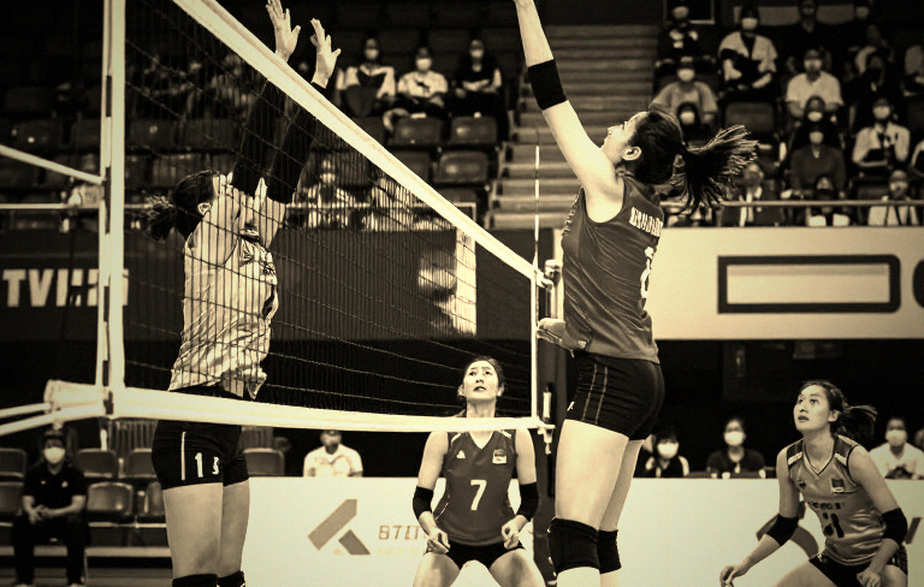
On the men's side the story has no comparable turning point. The men's team remains in the middle of the continental pack, and the gap to Asia's leading group has not narrowed; at times it has widened.
Alongside the national team, the domestic club system runs on its own calendar: the national championship is split into several phases, with mid-season transfer windows, plus the Hung Vuong Cup and invitational events such as the VTV Cup in Ninh Binh. That calendar was not designed to serve the national team. It was designed to serve broadcasters, sponsors and host provinces.
One small but telling detail: Tran Thi Thanh Thuy, the national team's key outside hitter, moved to play for PFU Blue Cats in Japan's V.League, becoming one of the first Vietnamese players to appear in Japan's domestic championship. That is a personal step forward. It also exposes a gap: when a leading player goes abroad, the domestic calendar offers no mechanism to protect her, and no mechanism to compensate the club that developed her.
The hot seat in Binh Duong in 2026 taught me this: the ball rolls first, the story follows after. Thirty years on, the principle holds when I analyse a national team. Every argument about "physique" or "spirit" only means something when you are willing to spend the time reading the smallest numbers.

Points and efficiency: two figures that never travel together
In volleyball there are two ways to describe a hitter. The first is to count points. The second is to calculate efficiency.
Points are the rallies a hitter finishes successfully. Efficiency is what remains after subtracting what they got wrong: spikes out of bounds, spikes into the opponent's block that get stuffed, spikes into the net. In other words, points are what the crowd sees; efficiency is what the opposing coach writes down.

Vietnam's women's team possesses one of the highest-scoring hitters in Southeast Asia at the opposite position: Nguyen Thi Bich Tuyen. The opposite position, let me be clear for those who follow the sport less closely, is the player on the right wing who usually receives the ball on the second tempo after the opposing block has drifted left, and who also has to swing in the hardest rallies.
Based on my experience of watching matches across many seasons, Vietnam's women's team has a very clear profile: high scoring volume, but efficiency that does not rise proportionally against taller, better-blocking opponents. Against weaker sides the point totals look like a greeting card. Against China, Japan or Thailand the picture changes completely.
The reason lies in height and contact point. When the opposing block reaches a peak of around two metres ninety or more, Vietnamese hitters are forced to raise their contact point, and every centimetre added costs power. The spike no longer travels downwards but diagonally, or sideways, or has to become a push through the block. A push can win a point, but it will almost never break an opponent's defensive system.
This is where my notebook differs from the organiser's statistics sheet. The organiser counts points. I count the number of times an attack forced the opponent to retreat, to rebuild their block on the next rally. A team that attacks well enough is not the team with the most points; it is the team that makes the opponent change how they block.
In Vietnam's matches on the continental stage, the ability to force that change came largely from one player. When that player is locked down on the first tempo, the whole attacking system loses its axis. That is a structural problem, not a form problem.
The reception threshold
There is a concept Vietnamese television almost never explains, and because of that audiences constantly misjudge matches: the perfect pass.
A perfect pass is a reception after the opponent's serve that travels to the right spot, at the right height and at the right moment for the setter to distribute to all three attacking positions, including the quick attack in the middle. With a perfect pass, the setter has three options. With a merely acceptable pass, there is only one: a high ball to the wings.
From watching many hundreds of sets of Vietnamese volleyball at club and national-team level, I have settled on a threshold I use as a personal marker in my notebook: when a team's perfect-pass rate falls below roughly forty per cent within a set, that team's attacking system almost certainly collapses into a two-player game.
What happens when the system becomes a two-player game? The opposing block knows where the ball is going. They do not need to read; they only need to wait. And when the block does not need to read, the defence behind it is already in position, because they know which way the ball will be blocked. An entire chain reaction begins with a pass that misses by thirty centimetres.
For Vietnam's women's team, reception is the most volatile phase between sets. In the early sets, with full energy and high concentration, the perfect-pass rate stays high enough for the setter to run the offence. By the third and fourth sets, as accumulated movement and psychological pressure build, that figure drops sharply. The coaching bench sees it in the live statistics. The crowd sees it as a feeling that "we are playing badly this set". Both are right, but only one side understands why.
Blocking: choosing between two ways to lose
In blocking, Vietnamese volleyball faces a choice with no right answer.
The first way is read blocking. The block waits, watches the setter's hands, moves with the ball and puts hands up late. This rarely produces direct block points, but it preserves the defensive structure behind, because the block is not dragged out of position. The second way is commit blocking. The block jumps early with the opposing setter, shuts down the quick attack, and is ready to score with the block, but if it guesses wrong the space behind is wide open.
Vietnamese volleyball, men's and women's alike, has a tradition of good floor defence. It is a strength built across generations, from roofless arenas to modern indoor halls. With the quality of defenders available, read blocking suits the personnel. But it carries a price: Vietnam's direct block points are usually lower than those of teams in the same continental bracket.
That price is only worth paying if the block reads well enough. Reading is the hardest skill in volleyball, because the blocker must process three streams of information at once: the direction of the opponent's reception, the body shape of the setter, and the tendencies of the hitter they have studied since the previous match. No software teaches that skill. It only comes from hours of video.
In recent continental matches I noted one detail: Vietnam's successful blocks mostly fall into two situations, either a double block on the wing when the opponent is forced into a high ball, or a single block in a lightning counter-attack. The rest of the time, when the opponent runs a fast, evenly distributed offence, Vietnam's block usually arrives half a tempo late.
Half a tempo, at the elite level, is everything.
Serving and the ace-to-error ratio
Serving is the only phase in volleyball in which an individual can decide the outcome without depending on team-mates. That also makes it the most misjudged phase.
I always track two figures together: direct aces and service errors. Look only at the first and a big server looks impressive. Look at both and the picture changes.
Tactically, a serve does not have to score. It only has to break the opponent's perfect pass. This is the difference between serving to score and serving to break the offence. A serve designed to break the offence usually targets a specific spot: the weakest receiver, the corridor between two receivers, or the seam between a receiver and the libero.
In many matches involving Vietnamese national teams, I see a leaning towards serving to score. Jump serves and float serves are hit at full power, and the consequence is a spike in errors during tense sets. A missed serve does not only cost a point. It hands the opponent a rally that costs them no energy, and in a five-set match that is an energy saving the opponent does not deserve.
At a concentrated event such as the Asian Games or a continental qualifier, where teams play on consecutive days with short rest, fitness is the currency with the highest interest rate.
The setter: the one who sets the rhythm
There is a saying I learned from old teachers in Binh Duong: the setter is not the person who delivers the ball, but the person who sets the tempo for the whole orchestra.
In volleyball, attacking tempos are graded. Tempo one is the quick attack right beside the setter, usually for the middle blocker. Tempo two is a medium-speed ball to the wings. Tempo three is a high, slow ball with enough time for the hitter to approach and swing. A good setter forces the opposing block to prepare for all three tempos at once.
Setter quality decides whether the middle blockers are weapons or merely people standing in the right place. If the setter does not trust the middles, they will not set them, and the opposing block immediately ignores the centre of the net. From then on, every rally goes to the wings, and the wing hitters face a double block on almost every ball.
For Vietnam's women's team, I believe this is the area most in need of investment over the next two years. Not because Vietnamese setters are weak. Because the number of setters good enough to start at national-team level is too small. One ankle injury, one absence for personal reasons, and the entire attacking architecture has to be rewritten.
On a related note, I once wrote about mispronouncing a player's name in Russia in 2026. In Russia in 2026, I corrected one name and touched an entire culture. In volleyball, getting a player's name right matters especially, because for years most of our athletes were never called by their full names in the media. A player exists in the audience's memory only when their name is spoken correctly.
The bench and a gap that cannot be hidden
This is the most important part of the story.
A volleyball squad has twelve to fourteen players, but only seven play at any moment. The gap between the starters and the bench decides how far a team goes in a concentrated tournament.
I have followed domestic competitions and the national team for many years, and a pattern repeats: that gap is very large in the attacking positions. When a starting hitter leaves the court, the team's scoring output falls by an amount anyone can see, even someone who does not know the rules. Two reasons explain it.
First, the replacement has not played enough matches under pressure. International experience cannot be replaced by training. You can practise blocking against team-mates ten thousand times, but only blocking an international hitter in the fifth set of a decisive match teaches you how to read a situation.
Second, the attacking system is not designed with a second option. When a team is built around one hitter, it usually does not build a fallback offence for that player's absence. That is a rational choice in a short tournament and a wrong choice across a four-year Olympic cycle.
I remember a club I once followed in the national league. They reached the final after a beautiful run, and the media called it the triumph of a collective. I went back through the footage. They met the two strongest opponents on the other side of the draw, thanks to the draw. One of their hitters played the match of her life exactly in the semi-final. It is a beautiful story. It is not evidence of a system.
A contrarian view: small victories are not big systems
In recent years Vietnamese women's volleyball has collected titles at lower-tier continental events, and each time the media talks about a turning point. I do not deny the achievements. I only place them at their proper scale.
A team that wins a short tournament needs three conditions at once: a good enough squad, a favourable draw, and a few individuals peaking at the right moment. The latter two are highly random. They do not measure the strength of a volleyball nation. They measure that in that particular week, in that particular hall, that particular person played her best.
If we use short-term titles as the yardstick for long-term investment, we will repeat a familiar cycle: euphoria after one tournament, cuts after two years without results, then euphoria again at the next event. Volleyball does not run on the emotional cycle of the audience. It runs on the development rate of a fifteen-year-old, which takes eight to ten years to show results.
When the media runs faster than the ball, the storyteller has to know when to stop. I choose to stop here: between a medal and a sustainable volleyball nation there is a distance no trophy can fill.
Load management and its romance
In modern sport the phrase load management appears more and more. It sounds very scientific, and sometimes it genuinely is. But I have watched enough to see a repeating pattern.
A player is rested in a domestic competition, then appears in a commercial friendly with a bigger crowd. An injury is described as minor when the national team needs her, and becomes serious once the domestic season ends. Reduced load does not always serve the athlete. Often it serves the calendar of whoever pays the bills.
In Vietnamese volleyball this problem is more serious than in football in one respect: far fewer players are good enough for national-team level, so the pressure concentrates on a very small group. A player must start for her club in the national championship, report to the national team for continental events, and appear in invitational tournaments. No mechanism binds these three parties together. Only one person bears the consequences.
Looking sideways: an ecosystem without a safety net
I want to give this section to a group of athletes I follow more and more.
Esports is where young people run faster than my generation, but they still need someone to retell the journey. The career span of a professional esports player is shorter than that of a volleyball player. Meanwhile, Vietnam's esports youth development and post-retirement support systems are close to zero. No long-term training centre, no career transition programme, no injury support fund.
What is striking is that the structure of the problem is identical to volleyball, differing only in speed. A small group of athletes under heavy pressure, a thin development system, a competition calendar decided by commercial operators, and a complete void after the career ends. Volleyball has an advantage in that it has a local club system and a provincial development tradition. But that advantage is narrowing.
I once wrote that a transfer contract is a map of sold dreams. Reading that map, what matters is not where players go, but where they cannot go.
What needs to be visible before 2026
When I sat down in Ninh Binh after that match, what I wrote at the bottom of the page was not the score. I wrote one sentence: this team did not lose the last rally, they lost the twelfth rally of the third set.
That is also how I think about Vietnamese volleyball in the cycle leading to the 2026 Asian Games. The current squad is settled, with quality individuals, a tactical identity, and matches capable of troubling stronger opponents. What is missing is depth, cover in decisive positions, and a mechanism to protect players from a calendar designed by others.
At fifty-two, I have come to realise that every arena is a universe and every player is trying to find the way home. The job of a sports writer, and I believe this after thirty-six years at the edge of the court, is to redraw that road accurately enough that those who follow do not have to start again from the beginning.
The question I want to leave is not where Vietnam will finish in Aichi-Nagoya. It is this: over the next four years, will we be willing to count the strokes instead of only the points, or will we keep applauding at precisely the wrong moment?